
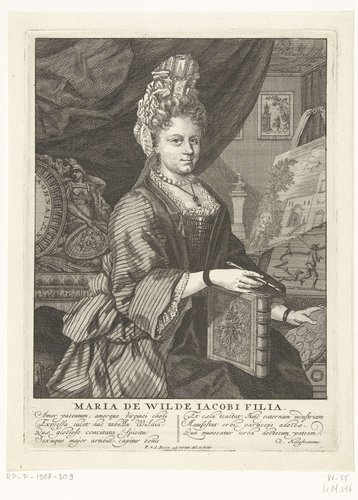
Portret van Maria de Wilde
in or after 1700 - c. 1730
Medium
etching
Dimensions
208; 155
Rights
Public Domain
About this artwork
ets
Art Historical Context
Created in the early decades of the eighteenth century, *Portret van Maria de Wilde* is a finely executed etching by the Dutch printmaker Pieter van den Berge. Measuring just over 20 centimetres in height, the small sheet demonstrates the intimate scale often favoured for portrait prints intended for private collections or books. Van den Berge worked during a period when etching had become a preferred medium for Dutch artists seeking both precision and a lively, sketch-like quality. Etching allowed the artist to draw directly onto a prepared copper plate with a needle, then bite the lines into the metal with acid. This technique produced delicate, varied strokes that could suggest the textures of fabric, hair, and lace with remarkable economy. In van den Berge’s hands, the medium captures not only the sitter’s features but also the refined dress and composed bearing expected of an early-eighteenth-century portrait. Although little is documented about Maria de Wilde herself, the existence of her etched likeness indicates she belonged to a circle considered worthy of remembrance. Such prints circulated among family, friends, and scholars, preserving individual identities long after the sitter’s lifetime and offering today’s viewers a vivid glimpse into Dutch social and artistic life around 1700.
About the Artist
Pieter van den Berge · 1669–1769
Pieter van den Berge (1659–1737) was a Dutch draughtsman, printmaker, and publisher whose long career spanned the late Dutch Golden Age into the early 18th century. Born in 1659, likely in Amsterdam, van den Berge worked as an engraver, visual artist, editorial curator, and draughtsman during a period when Dutch printmaking was transitioning from the heights of the Golden Age into new commercial a...