
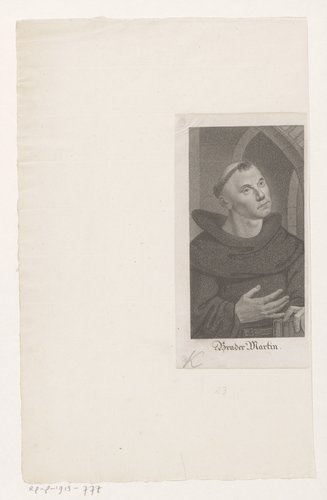
Portret van Martin Luther
Medium
stipple engraving
Dimensions
155; 83
Rights
Public Domain
About this artwork
blad: hoogte 155 mm (binnen de plaatrand afgesneden) x breedte 83 mm (binnen de plaatrand afgesneden)
Art Historical Context
**Portret van Martin Luther** is a delicate stipple engraving created by Friedrich Wilhelm Meyer () in 1817, measuring just 155 mm high by 83 mm wide—trimmed neatly within the plate marks for a compact presentation. This intimate portrait captures the likeness of Martin Luther, the seminal figure of the Protestant Reformation, whose 16th-century challenges to the Catholic Church reshaped European Christianity and ignited widespread cultural shifts. Stipple engraving, the chosen medium, exemplifies a refined 19th-century printmaking technique where artists build tones and textures through meticulously placed dots rather than lines. This method allowed Meyer to achieve subtle shading and lifelike depth on a small scale, making the image ideal for personal collections, books, or devotional use. Popular in the Romantic era, such engravings democratized access to revered historical portraits, bridging the gap between elite art and everyday audiences. Rendered over 270 years after Luther's death, this work reflects enduring fascination with his legacy during a time of renewed religious and nationalistic fervor in Europe. Visitors will appreciate its technical precision and the way it immortalizes a reformer whose ideas continue to echo in modern thought.