
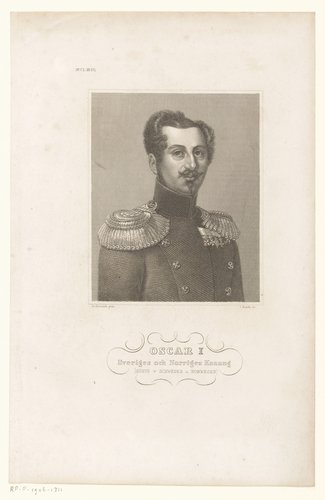
Portret van Oscar I
1844 - 1853
Medium
steel engraving
Dimensions
232; 151
Rights
Public Domain
About this artwork
collector's mark: Lugt 2228
Art Historical Context
**Portrait of Oscar I** by Karl Barth (1844–1853) is a fine example of 19th-century steel engraving, capturing the likeness of Sweden and Norway's King Oscar I during the early years of his reign, which began in 1844. Barth, a skilled engraver of the period, produced this intimate portrait (232 × 151 mm) likely as a print for dissemination among the nobility and collectors, reflecting the era's fascination with royal iconography amid Europe's monarchies. Steel engraving, a technique pioneered in the early 1800s, revolutionized printmaking by allowing sharper, more durable lines than traditional copper plates. This medium enabled Barth to render fine details in Oscar I's regal attire, facial features, and dignified pose, making high-quality reproductions affordable and widespread. Such portraits served not only as personal mementos but also as tools for fostering loyalty to the crown in an age of political change. Bearing the collector's mark Lugt 2228—indicative of a distinguished provenance—this artwork highlights the enduring value of engraved royal portraits in art history. It offers visitors a window into mid-19th-century Scandinavian culture, where precision craftsmanship met monarchical prestige.
About the Artist
Karl Barth · 1787–1853
Karl Barth (also known as Carl Barth or Johann Carl Barth, 1787–1853) was a versatile German artist who worked as a copperplate engraver, draughtsman, painter, illustrator, and portrait engraver during the late eighteenth and first half of the nineteenth centuries. Born in Eisfeld in the Duchy of Saxe-Meiningen and dying in Kassel, Barth exemplified the multi-talented artist-craftsman of the Roman...