
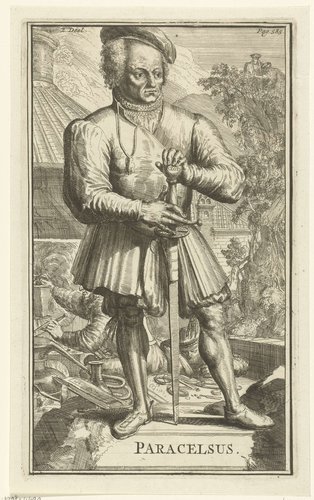
Portret van Paracelsus
1701
Medium
etching
Dimensions
265; 160
Rights
Public Domain
About this artwork
plaatrand: hoogte 265 mm x breedte 160 mm
Art Historical Context
### Portret van Paracels Created in 1701 by the prolific Dutch artist Romeyn de Hooghe *Portret van Paracus* is a striking etching measuring 265 mm high by 160 mm wide. De Hooghe, a master of Baroque printmaking, was renowned for his intricate illustrations, satirical works, and historical portraits during the Dutch Golden Age's twilight. This piece captures the likeness of Paracelsus, the Renaissance polymath whose real name was Philippus Aureolus Theophrastus Bombastus von Hohenheim (1493–1541), a Swiss physician, alchemist, and philosopher who revolutionized medicine by challenging ancient authorities and emphasizing empirical observation. Etching, de Hooghe's favored medium, allowed for precise, expressive lines that convey depth and character in portraiture—ideal for immortalizing influential figures like Paracelsus. At a compact size, the print was likely designed for collectors' albums or scholarly books, reflecting the era's fascination with Renaissance innovators amid the Enlightenment's dawn. Paracelsus's legacy as a bridge between medieval mysticism and modern science made him a cultural icon, blending alchemy's enigma with groundbreaking toxicology. This artwork invites visitors to ponder how 18th-century artists like de Hooghe preserved the rebellious spirit of Renaissance thinkers, reminding us of art's role in honoring intellectual trailblazers. (198 words)
About the Artist
Romeyn de Hooghe · 1645–1708
Romeyn de Hooghe (1645-1708) was a Dutch Baroque engraver, draughtsman, and political satirist who became the most prolific and versatile graphic artist of the Dutch Republic in the late seventeenth century. Born in Amsterdam, he rose to become one of early modern Europe's most important printmakers and a pioneering master of political satire. De Hooghe's significance extends far beyond his techn...