
Portret van Polycarp Wirth
1655
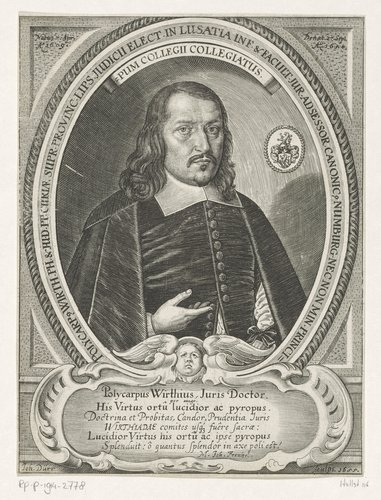
Medium
engraving
Dimensions
139; 183
Rights
Public Domain
About this artwork
blad: hoogte 183 mm (binnen plaatrand afgesneden) x breedte 139 mm (binnen plaatrand afgesneden)
Art Historical Context
Created in 1655 by German engraver Johann Dürr, this portrait of Polycarp Wirth exemplifies the refined printmaking traditions of the mid-17th century. Rendered as a modest engraving measuring just 183 by 139 millimeters, the work was likely produced for circulation in books, albums, or private collections rather than as a standalone wall piece. The trimmed plate edges visible in the sheet suggest it was carefully prepared for such intimate viewing. Engraving allowed artists like Dürr to capture fine details and tonal gradations through precise incised lines, a technique well suited to commemorating scholars, clergy, or civic figures of the period. In an age when painted portraits remained costly luxuries, prints like this one helped broaden access to likenesses of notable individuals across Europe. Dürr’s measured approach reflects the Baroque era’s interest in clarity and intellectual presence, transforming a simple sheet of paper into a lasting record of personal and cultural identity.
About the Artist
Johann Dürr · 1600–1663
Johann Dürr (1600–1663) was a German copperplate engraver who worked primarily in Weimar during the mid-17th century, producing prints for court and scholarly patrons during the tumultuous period of the Thirty Years' War. Born in 1600, Dürr's career spanned one of the most devastating periods in German history, when religious conflict and military campaigns brought widespread destruction to German...