
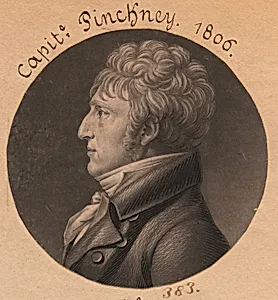
Possibly Charles Pinckney or Dr. George Wilson
Medium
Classification
Department
Smithsonian Collection
Museum
Smithsonian American Art Museum
Credit
National Portrait Gallery, Smithsonian Institution; gift of Mr. and Mrs. Paul Mellon
Accession Number
S/NPG.74.39.9.6
Rights
Public Domain
Tags
Art Historical Context
This intriguing print from 1806, titled *Possibly Charles Pinck or Dr. George Wilson captures the refined profile of an early American figure, created by French engraver Charlesalthazar Julien Fév de Saint-Mémin1770–1852). Saint-Mémin, who fled the French Revolution and settled in the United States, became renowned for his precise portrait miniatures of the nation's elite during the Federal period. Saint-Mémin pioneered a novel technique using the physiognotrace, a mechanical pantograph device that traced sitters' profiles onto paper. He then hand-colored delicate watercolor profiles and engraved them into small, affordable prints like this one—typically 2 by 3 inches—allowing wider distribution among collectors. This method blended Enlightenment-era science with artistry, producing strikingly accurate likenesses that democratized portraiture in post-Revolutionary America. The subject may be Charles Pinckney, the charismatic South Carolina statesman and Constitution signer, or Dr. George Wilson, reflecting the era's prominent men. Housed in the Smithsonian American Art Museum through a gift from Mr. and Mrs. Paul Mellon, this work highlights early 19th-century portraiture's role in shaping national identity, offering visitors a window into the faces behind America's founding story.