
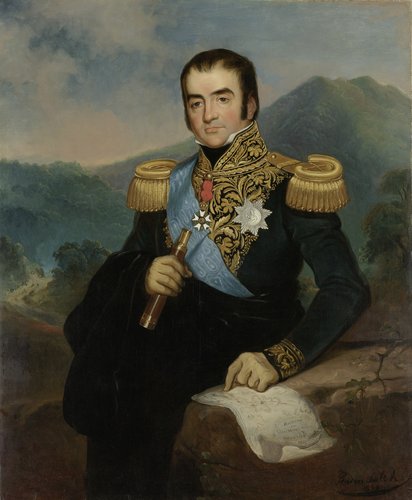
Posthumous Portrait of Herman Willem Daendels, Governor-General of the Dutch East Indies
Medium
oil on canvas
Dimensions
119; 6; 98
Rights
Public Domain
About this artwork
oil on canvas
Art Historical Context
Step into the Rijksmuseum and gaze upon this striking *Posthumous Portrait of Herman Willem Daendels Governor-General of the Dutch Indies* (1838), crafted by the trailblazing Indonesian artist Raden Sarief Bast Saleh. Measuring 119 x 98 cm, this oil on canvas captures Daendels, who died in 1818, with a dignified poise that honors his legacy. Saleh, a Javanese nobleman born in 1811, painted it two decades after the subject's passing, likely drawing from earlier likenesses to evoke the statesman's commanding presence. Daendels served as Governor-General from 1808 to 1811 during a turbulent era of Dutch colonial rule in the East Indies (modern Indonesia). Known for ruthless efficiency, he overhauled administration, built the vital Great Post Road across Java, and bolstered defenses against British threats—reforms that reshaped the colony but at great human cost. Saleh, one of the first Indonesians trained in Europe (studying in the Netherlands and Paris), mastered Romantic portraiture here, blending Western realism with subtle Eastern sensitivity. This work's cultural weight lies in its creator: Saleh bridged colonial and indigenous worlds, introducing oil painting techniques to Indonesia and later championing nationalist themes. A testament to artistic ambition amid empire, it invites reflection on power, legacy, and cross-cultural exchange. (198 words)
About the Artist
Raden Sarief Bastaman Saleh
**Raden Saleh Sjarif Boestaman (also known as Raden Sarief Bastaman Saleh)** was a pioneering Romantic painter of Arab-Javanese descent, widely recognized as Indonesia’s first modern artist. Born around 1811 in Terboyo near Semarang in the Dutch East Indies (present-day Indonesia), he came from a noble Hadhrami family. Raised by an uncle who served as regent of Semarang, the young nobleman showed ...