
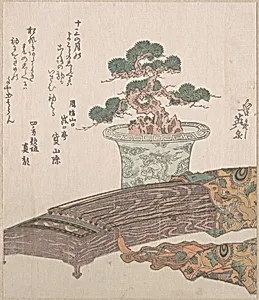
Potted Pine Tree and Koto (Japanese Harp)
19th century
Medium
Part of an album of woodblock prints (surimono); ink and color on paper
Dimensions
7 3/4 x 6 9/16 in. (19.7 x 16.7 cm)
Classification
Prints
Culture
Japan
Department
Asian Art
Museum
Metropolitan Museum of Art, New York, NY
Credit
H. O. Havemeyer Collection, Bequest of Mrs. H. O. Havemeyer, 1929
Accession Number
JP2319
Rights
Public Domain
Tags
Art Historical Context
In the serene composition *Potted Pine Tree andoto (Japanese Harp)*, 19th-century ukiyo-e master Keisai Eisen captures a harmonious still life that evokes Japan's elegant aesthetic traditions. Created as part of a surimono album—a form of woodblock print often commissioned for private poetry gatherings or New Year's celebrations—this intimate work measures just 7 3/4 x 6 9/16 inches. Eisen, renowned for his refined depictions of beauty and everyday elegance during the late Edo period, employs ink and color on paper to render the glossy leaves of a potted pine tree alongside the graceful curves of a koto, a traditional stringed harp central to classical Japanese music. Surimono prints like this one stand out for their technical sophistication, featuring vibrant colors, subtle gradations (known as *bokashi*), and sometimes embossing or metallic accents for a tactile quality. The pine, a symbol of longevity and resilience in Japanese culture, paired with the koto—evoking poetic melodies—reflects the era's appreciation for nature's quiet poetry and artistic refinement. Housed in the Metropolitan Museum of Art's Asian Art Department as part of the esteemed H. O. Havemeyer Collection (bequest of 1929), this piece offers visitors a window into the private, cultured world of Edo Japan's literati, where art intertwined with seasonal rituals and intellectual pursuits.
About the Artist
Keisai Eisen · 1790–1848
Keisai Eisen (1790–1848), born Ikeda Yoshinobu in Edo (modern Tokyo), emerged as one of the late Edo period's most prolific ukiyo-e masters. The son of the renowned calligrapher and Kanō-school painter Ikeda Shigeharu, Eisen was immersed in the arts from childhood. He apprenticed under Kanō Hakkeisai, adopting the art name "Keisai" in homage to his teacher, and later studied bijin-ga (images of be...