
Potted Plant and Almanac
1817
Medium
nishikie
Dimensions
190; 174
Rights
Public Domain
About this artwork
Legaat van J.A. Bierens de Haan, Amsterdam
Art Historical Context
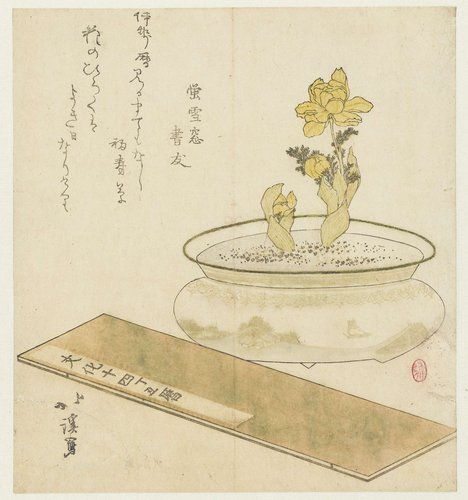
**Potted Plant and Almanac** (1817) by Totoya Hokkei invites visitors into the refined world of late Edo-period Japan. Hokkei (1791–1841), a skilled ukiyo-e artist pupil of the master Katsushika Hokusai, specialized in intimate, poetic prints that captured everyday beauty. Created during a time when woodblock printing flourished in urban centers like Edo (modern Tokyo), this small-scale work—measuring just 190mm high by 174mm wide—exemplifies the artist's talent for transforming humble subjects like a potted plant and almanac into harmonious compositions, evoking seasonal tranquility and the rhythm of daily life. Printed in *nishikie* (brocade pictures), a vibrant full-color woodblock technique using multiple carved blocks inked in nuanced hues, the medium brought unprecedented realism and depth to Japanese art. Nishikie prints, popular from the 1760s onward, democratized beauty for a growing merchant class, blending artistry with craftsmanship. Hokkei's precise lines and subtle shading highlight the textures of leaves and paper, a nod to ukiyo-e's "floating world" aesthetic celebrating transience. This piece forms part of the legacy of J.A. Bierens de Haan, bequeathed to Amsterdam's collections, underscoring its journey from Japan to European appreciation. A gem for collectors, it reminds us how such modest scenes preserve cultural snapshots of 19th-century Japan. (198 words)
About the Artist
Totoya Hokkei · 1780–1850
Totoya Hokkei (魚屋 北渓, 1780–1850), born Iwakubo Tatsuyuki in Edo (modern Tokyo), began his life as a humble fishmonger in the Yotsuya Samegahashi district, a trade reflected in his art name "Totoya," meaning fish shop. He transitioned to art through rigorous training, first studying under Kanō Yōsen'in Korenobu, head of the Kobikichō branch of the prestigious Kanō school, where he honed landscape p...