
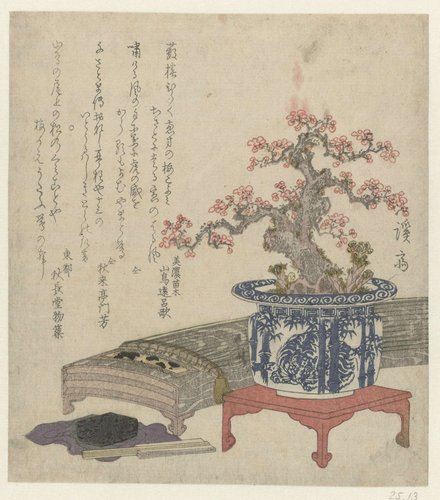
Koto met pruimenbloesem in pot
1830
Medium
nishikie, with metallic pigments
Dimensions
171; 192
Rights
Public Domain
About this artwork
height 192 mm x width 171 mm
Art Historical Context
**Koto met Pruimenbloesem in** by Keisai Eisen (0–1848) is a delicate nishikie woodblock print 1830, capturing the refined elegance of Edo-period Japan. Eisen, a prominent uki-e artist and pupil of Kikugawaizan, was renowned for his bijin-ga (images of beautiful women) and intimate genre scenes. Created during the late Edo era, when woodblock printing flourished amid urban prosperity, this small-scale work (192 × 171 mm) likely served as a surimono—a privately commissioned print for poetry gatherings or New Year's gifts—evoking seasonal beauty and cultural sophistication. The composition features a koto, the traditional Japanese zither symbolizing musical grace and courtly refinement, paired with plum blossoms in a pot. These early-blooming flowers held deep cultural significance, representing perseverance, renewal, and the fleeting beauty of life in Japanese poetry and art. The nishikie medium, or "brocade picture," shines through its vibrant colors and metallic pigments, which add a luxurious shimmer mimicking brocade textiles. This technique elevated ukiyo-e from mass-produced ephemera to treasured art objects, showcasing printers' mastery of multi-block carving and precise color registration. Eisen's subtle lines and harmonious palette invite viewers to appreciate the quiet poetry of everyday elegance, bridging art and ritual in 19th-century Japan. A gem for ukiyo-e enthusiasts, it reminds us of printmaking's role in democratizing beauty. (198 words)
About the Artist
Keisai Eisen · 1790–1848
Keisai Eisen (1790–1848), born Ikeda Yoshinobu in Edo (modern Tokyo), emerged as one of the late Edo period's most prolific ukiyo-e masters. The son of the renowned calligrapher and Kanō-school painter Ikeda Shigeharu, Eisen was immersed in the arts from childhood. He apprenticed under Kanō Hakkeisai, adopting the art name "Keisai" in homage to his teacher, and later studied bijin-ga (images of be...