
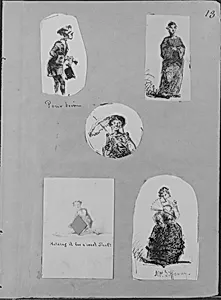
Pour Boire (from Sketchbook)
1854–55
Medium
Ink and graphite on off-white wove paper, unevenly clipped
Dimensions
2 15/16 x 1 5/8 in. (7.5 x 4.1 cm)
Classification
Drawing
Culture
American
Department
The American Wing
Museum
Metropolitan Museum of Art, New York, NY
Credit
Gift of Margaret C. Buell, Helen L. King, and Sybil A. Walk, 1970
Accession Number
1970.121.46
Rights
Public Domain
Tags
Art Historical Context
Nestled in the Metropolitan Museum of Art's American Wing, *Pour Boire* (from Sketchbook) is a charming, intimate ink and graphite drawing by James Mc Whistler, created around 1854–55. Measuring just 2 15/16 x 1 5/8 inches on off-white wove paperunevenly clipped for raw, spontaneous feel—this tiny work captures figures of men and women, likely in a convivial drinking scene, as suggested by its French title meaning "To Drink." At the time, the young Whistler, an American artist born in 1834, was honing his skills amid the vibrant artistic circles of Paris, blending precise graphite outlines with fluid ink washes. Whistler's early sketchbooks reveal his masterful draftsmanship and emerging sensitivity to line and tone, techniques rooted in 19th-century academic training yet foreshadowing his later Aesthetic movement innovations. The modest wove paper, a practical choice for portable studies, allowed for quick, expressive marks that prioritize gesture over finish—ideal for capturing everyday moments like this portrait-like tableau. Donated in 1970 by Margaret C. Buell, Helen L. King, and Sybil A. Walk, it offers a glimpse into Whistler's formative years before his fame for ethereal nocturnes and tonal harmonies. This gem highlights the cultural vibrancy of mid-19th-century American expatriates abroad, inviting visitors to appreciate the artistry in fleeting sketches that bridge personal observation and enduring legacy.
About the Artist
James McNeill Whistler · 1834–1903
James Abbott McNeill Whistler (1834-1903) was an American-born painter and printmaker who became a leading figure in the Aesthetic Movement and pioneer of Tonalism and Japonisme. He revolutionized art by championing "art for art's sake" and treating paintings as visual equivalents of musical compositions, titling works as "arrangements," "harmonies," and "nocturnes" to emphasize formal qualities o...