
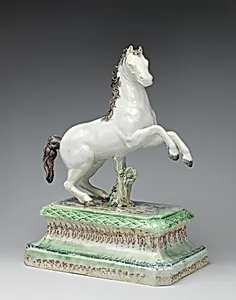
Prancing horse
ca. 1780
Medium
Lead-glazed earthenware
Dimensions
Height: 11 1/2 in. (29.2 cm)
Classification
Ceramics-Pottery
Culture
British, Burslem, Staffordshire
Department
European Sculpture and Decorative Arts
Museum
Metropolitan Museum of Art, New York, NY
Credit
Gift of R. Thornton Wilson, in memory of Florence Ellsworth Wilson, 1943
Accession Number
43.100.14
Rights
Public Domain
Tags
Art Historical Context
Created around 1780 by Ralph Wood the Younger in Burslem, Staffordshire, this charming *Prancing Horse* exemplifies the lively animal figures that helped define British pottery during the late eighteenth century. Wood, part of a renowned family of Staffordshire potters, worked in lead-glazed earthenware, a medium prized for its ability to capture fluid movement and bright, glossy surfaces. Standing just over eleven inches tall, the figure would have served as an affordable yet decorative accent for middle-class homes, reflecting the growing popularity of ceramic ornaments during the Industrial Revolution. Staffordshire potters like Wood blended folk traditions with emerging neoclassical tastes, modeling horses, dogs, and other creatures that appealed to both rural and urban buyers. The lead glaze not only enhanced the modeling’s details but also produced the rich, translucent colors that became a hallmark of the region’s output. Today, this piece in the Metropolitan Museum’s collection offers visitors a glimpse into the everyday artistry and technical skill that made Staffordshire ceramics a cornerstone of British decorative arts.
About the Artist
Ralph Wood the Younger · 1748–1795
Ralph Wood the Younger was born in Burslem, Staffordshire, in 1748, the son of the celebrated potter Ralph Wood the Elder and a member of a family that stood at the center of the Staffordshire ceramics industry during its most creative and internationally influential period. Growing up in the workshops of his father, he absorbed from childhood the technical traditions of English earthenware produc...