
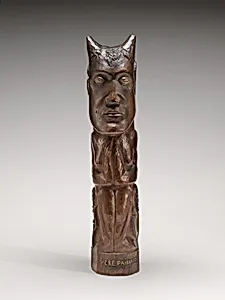
Père Paillard
1902
Medium
painted miro wood
Dimensions
overall: 67.9 x 18 x 20.7 cm (26 3/4 x 7 1/16 x 8 1/8 in.)
Classification
Sculpture
Department
CSD
Museum
National Gallery of Art, Washington, D.C.
Credit
Chester Dale Collection
Accession Number
1963.10.238
Rights
Public Domain
Art Historical Context
In the final years of his life, Paul Gauguin, the pioneering Post-Impressionist painter, turned increasingly to sculpture while living in the Marquesas Islands of French Polynesia. Created in 1902—just a year before his death—Père Paillard* a striking example of this late-phase experimentation. Carved from miro wood, a dense tropical hardwood native to the South Pacific, and vividly painted, the sculpture 67.9 x 18 x 20.7 cm. Its compact, totemic form reflects Gauguin's immersion in Polynesian culture, where he drew inspiration from local carving traditions to challenge European artistic norms. The title *Père Paillard*, translating roughly to "Father Lewd" or "Lecherous Priest," hints at Gauguin's provocative commentary on colonialism and missionary influence in Tahiti and the Marquesas. By blending bold, simplified forms reminiscent of Maori tikis with his signature bright colors and symbolic motifs, Gauguin elevated wood sculpture beyond mere craft. This piece, now in the National Gallery of Art's Chester Dale Collection, exemplifies his primitivist vision—merging exotic materials and themes to evoke spiritual and sensual vitality. Though small in scale, *Père Paillard* captures Gauguin's radical evolution, bridging Impressionism's legacy with Oceanic art's raw power, inviting visitors to ponder the artist's quest for an unspoiled paradise.
About the Artist
Paul Gauguin · 1848–1903
Paul Gauguin (1848-1903) was a French Post-Impressionist painter whose bold experiments with color, form, and subject matter made him one of the most influential figures in the transition from 19th-century art to modernism. His rejection of European civilization for the perceived authenticity of 'primitive' cultures established an archetype of artistic exile that continues to resonate. Gauguin's ...