
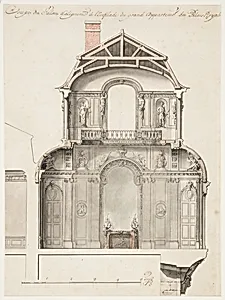
Preliminary Design for the Salon d'Angle at the Palais Royal, Paris, France
Classification
architecture
Department
Smithsonian Collection
Museum
Smithsonian American Art Museum
Credit
Purchased for the Museum by the Advisory Council
Accession Number
1911-28-80
Rights
Public Domain
About this artwork
The sectional elevation shows a two-storied chamber, the second story indicated by a balcony. Roof construction is also shown.The design continues to the left with the outlines of a roof and the elevation of a wall, showing a dado and an entablature with brackets, and toward the lower right a section of the substructure. Details of interior include fireplace and mantle with candelabra, a large mirror, sculptures in niches, and richly ornamented walls. Remnant of a framing line at bottom edge.
Art Historical Context
Step into the opulent world of early 18th-century French with Gilles-Marie Oppenord's *Preliminary Design for the Salon'Angle at the Palais, Paris, France* (1719–20). Oppenord, a leading French architect and decorator (1672–1742), was renowned for his role in shaping the Rococo style, by lavish ornamentation and playful elegance. This intricate drawing, now in the Smithsonian American Art's collection, captures a preliminary vision for a grand corner salon in the Palais Royal—a lavish residence of the French nobility during the Regency era under Philippe II, Duke of Orléans. The sectional elevation reveals a sophisticated two-storied chamber, with a balcony marking the upper level and detailed roof construction overhead. To the left, faint outlines suggest an adjoining roof and wall elevation, featuring a dado, entablature with decorative brackets, and a section of substructure below. Inside, the space bursts with luxury: a prominent fireplace and mantel topped by candelabra, a towering mirror, sculptures nestled in niches, and walls alive with rich embellishments. A remnant framing line at the bottom hints at the drawing's preparatory nature. As a testament to Rococo's shift from rigid Baroque grandeur toward intimate splendor, this design highlights Oppenord's mastery in blending architecture with interior artistry. It offers a rare glimpse into the creative process behind Paris's iconic palaces, inviting us to imagine the candlelit soirées that once filled these gilded rooms.