
Presentation vase
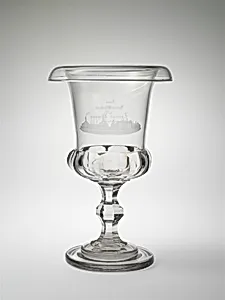
Medium
Blown, cut, and engraved glass
Dimensions
H. 13 in. (33 cm)
Classification
Presentation vase
Culture
American
Department
The American Wing
Museum
Metropolitan Museum of Art, New York, NY
Credit
Purchase, Judith F. and William H. Hernstadt Gift, and Robert G. Goelet Gift, 1980
Accession Number
1980.69
Rights
Public Domain
Tags
Art Historical Context
This elegant *Presentation Vase* from the New England Glass Company, crafted in 1843, the burgeoning artistry of American glassmaking during the early industrial era. Standing at 13 inches (33 cm) tall, it was produced by one of New England's pioneering factories, which played a key role in elevating domestic glass production to rival European imports. As a "presentation" piece, it likely served as a ceremonial gift, highlighting the era's growing appreciation for finely crafted luxury goods among America's emerging middle and upper classes. The vase's medium—blown, cut, and engraved glass—showcases sophisticated techniques that transformed molten glass into a multifaceted work of art. Blowing created the vase's graceful form, while cutting and engraving added intricate patterns, reflecting the precision and skill of factory artisans. These methods not only enhanced aesthetic appeal through light-reflecting facets and detailed motifs but also demonstrated technological advances in 19th-century American manufacturing. Housed in The Metropolitan Museum of Art's American Wing, this vase underscores the cultural significance of U.S. decorative arts in the 1840s, a time when factories like New England Glass fostered national pride in craftsmanship. Its acquisition through generous gifts in 1980 preserves a tangible link to America's inventive spirit.
About the Artist
New England Glass Company · 1818–1888
**The New England Glass Company: Pioneers of American Flint Glass** The New England Glass Company was established on February 16, 1818, in East Cambridge, Massachusetts, by a quartet of prominent local businessmen: Amos Binney, Edmund Munroe, Daniel Hastings, and Deming Jarves. Jarves, drawing on his dry goods background and talent for recruiting Europe's finest cutters, served as operational man...