
Prick Spur
Unknown Artist
12th century
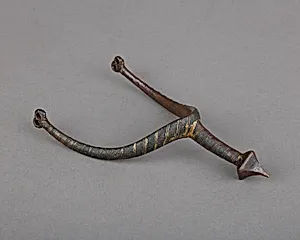
Medium
Copper alloy, gold
Dimensions
L. 5 1/4 in. (13.3 cm); W. 3 in. (7.6 cm); Wt. 2.8 oz. (79.4 g)
Classification
Equestrian Equipment-Spurs
Culture
German
Department
Arms and Armor
Museum
Metropolitan Museum of Art, New York, NY
Credit
Gift of Stephen V. Grancsay, 1942
Accession Number
42.50.260
Rights
Public Domain
Art Historical Context
Step into the world of medieval chivalry with this 12th-century German *Prick Spur*, a finely crafted piece of equestrian equipment now housed in the Metropolitan Museum Art's Arms and Armor. Measuring 5¼ inches long and weighing just 2.8 ounces, this yet functional spur was designed for mounted warriors, featuring a sharp prick point rather than the later wheeled rowel, allowing precise control of a warhorse during battle or tournaments. Forged from copper alloy and adorned with gold, the spur exemplifies the superior metallurgy of the Holy Roman Empire era. The gilding not only enhanced its durability against corrosion but also elevated its status as a symbol of knighthood and nobility—practical tools transformed into emblems of power. Spurs like this were essential for knights, who relied on their steeds for dominance on the battlefield, reflecting the era's fusion of craftsmanship and martial culture. Gifted to the Met in 1942 by collector Stephen V. Grancsay, this anonymous masterpiece invites us to ponder the lives of its unseen owner: a rider galloping through feudal Germany, where every glint of gold underscored valor and hierarchy. A testament to medieval ingenuity!