
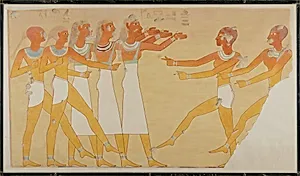
Priestesses and Dancers
A.D. 1914–1915; original ca. 1970–1917 B.C.
Medium
Tempera on paper
Dimensions
facsimile: h. 32 cm (12 5/16 in); w. 57 cm (22 7/16 in), scale 1:3, framed: h. 35.6 cm (14 in); w. 59.7 cm (23 1/2 in)
Classification
Facsimile, Senet (TT 60), Intefiqer, priestesses, dancers
Period
Twentieth Century; original Middle Kingdom
Department
Egyptian Art
Museum
Metropolitan Museum of Art, New York, NY
Credit
Rogers Fund, 1930
Accession Number
30.4.160
Rights
Public Domain
Tags
Art Historical Context
This striking facsimile captures a lively scene of priestesses and dancers from ancient Egypt’s Middle Kingdom, Dynasty 12. Created by artist Hugh R. Hopgood in 1914–1915 using tempera on paper, it reproduces an original wall painting from around 1970–1917 B.C. at a scale of 1:3. Now housed in the Metropolitan Museum of Art’s Department of Egyptian Art, the work offers modern viewers an intimate glimpse into rituals that once animated temple and tomb spaces. In ancient Egyptian culture, dance played a vital role in religious ceremonies, often performed by women to honor deities and ensure cosmic harmony. The original composition likely adorned a tomb or chapel, celebrating both earthly joy and the promise of eternal life. Hopgood’s careful facsimile preserves the graceful poses, flowing garments, and rhythmic energy of these figures, allowing today’s audiences to appreciate the artistry and symbolism that defined Middle Kingdom visual traditions. As a museum reproduction made nearly a century ago, this piece also highlights early twentieth-century efforts to document and share Egypt’s artistic heritage. Its warm tones and delicate brushwork invite visitors to imagine the music and movement that once accompanied such scenes, bridging millennia through faithful artistic interpretation.