
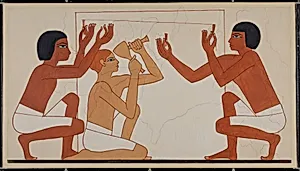
Masons Squaring a Block, Tomb of Rekhmire
ca. 1479–1425 B.C.
Medium
Tempera on Paper
Dimensions
h. 25 cm (9 13/16 in); w. 40.5 cm (15 15/16 in), scale 1:1
Classification
Restored copy, Rekhmire (TT 100)
Period
New Kingdom
Department
Egyptian Art
Museum
Metropolitan Museum of Art, New York, NY
Credit
Rogers Fund, 1931
Accession Number
31.6.23
Rights
Public Domain
Tags
About this artwork
This Masons Squaring a Block, Tomb of Rekhmire by Nina de Garis Davies dating to ca. 1479–1425 B.C. exemplifies the artistic traditions of New Kingdom, Dynasty 18, Upper Egypt, Thebes. Created in tempera on paper, the work demonstrates technical mastery of materials and processes characteristic of New Kingdom, Dynasty 18, Upper Egypt, Thebes artisans. As part of the Metropolitan Museum of Art's Egyptian Art, this piece contributes to our understanding of historical artistic production. The work'...
Art Historical Context
Step into the bustling workshops of ancient Egypt with *Masons Squaring a* from the Tomb of Rekire, a vivid tempera-on-paper facsimile created by Nina de Garis Davies. Dating to the New Kingdom's Dynasty 18 (ca. 1479–1425 B.C.), this scene captures artisans meticulously shaping a stone block, showcasing the precision and skill of Theban craftsmen in Upper Egypt. At 25 x 40.5 cm and rendered at a 1:1 scale, Davies' work faithfully reproduces the original tomb painting from Rekhmire's elaborate burial chamber in Thebes, acquired by The Metropolitan Museum of Art through the Rogers Fund in 1931. These depictions of daily labor were a hallmark of elite tombs like Rekhmire's—home to the powerful vizier under pharaohs Thutmose III and Amenhotep II—serving both to honor the deceased and magically ensure prosperity in the afterlife. By illustrating men at work with tools like squares and mallets, the artwork reveals the organized guilds and technical expertise behind Egypt's monumental architecture, from temples to pyramids. Davies, a pioneering 20th-century Egyptologist and artist, used tempera to preserve fading wall paintings with remarkable accuracy, bridging ancient traditions to modern audiences. This piece in the Met's Egyptian Art collection not only highlights New Kingdom aesthetic values but also illuminates the vital role of craftsmanship in one of history's greatest civilizations.
About the Artist
Nina de Garis Davies · 1881–1965
Nina de Garis Davies, born Anna Macpherson Cummings on January 6, 1881, in Salonika, Greece, to English-Scottish parents Cecil J. Cummings and Sarah Macintosh Tannoch, showed early artistic talent as the eldest of three daughters. After her father's death in 1894, the family relocated to Scotland and then London, where she trained at the Slade School of Art. In 1906, at age 25, a holiday trip to E...