
Priest's Hat
Late 19th century, Meiji period (1868–1912)
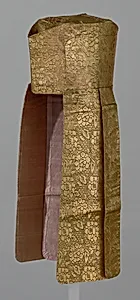
Medium
Silk and gilt-paper strip; plain weave with secondary binding warps and supplementary patterning wefts
Dimensions
58.7 × 28.6 cm (23 1/8 × 11 1/4 in.); Repeat Warp: 10.2 × 7 cm (4 × 2 3/4 in.)
Classification
textile
Department
Textiles
Museum
Art Institute of Chicago
Accession Number
183183
Rights
Public Domain
About this artwork
Priest's hats in a form similar to this resplendent example from the late 19th century are still worn today. The pattern of the fabric consists of two slightly different peony blossoms framed within scrolling vines and leaves. The use of deluxe kinran fabric, consisting of gilt-paper strips and silk, and the incorporation of a lining of purple, a color used only by high-ranking Buddhist officials, suggest that this hat belonged to a priest of high rank.
Art Historical Context
Step into the intricate world of textiles with *Priest's Hat*, a stunning artifact from Japan's Meiji period (1868–1912). Crafted in the late 19th century, this ceremonial headpiece reflects a time of profound transformation, as Japan rapidly modernized while preserving revered traditions like Buddhist and Shinto rituals. Worn by priests during religious ceremonies, it embodies the enduring spiritual life amid societal change, now housed in the Art Institute Chicago's Textiles Department. Masterfully woven from silk and gilt-paper strips, the hat employs a plain weave enhanced by secondary binding warps and supplementary patterning wefts. This sophisticated technique creates a repeatable motif (10.2 × 7 cm), where shimmering gilt elements catch the light, evoking divine radiance. Measuring 58.7 × 28.6 cm, its compact form highlights the weavers' precision—artisans who blended functionality with opulent decoration, a hallmark of Meiji craftsmanship. This piece invites us to appreciate the tactile artistry of textiles as cultural treasures, bridging the sacred and the everyday in imperial Japan.
About the Artist
Unknown
The artist designated as "Unknown" in our virtual museum's collection exemplifies a poignant chapter in art history: creators whose identities have faded into obscurity despite the enduring power of their work. With only one known artwork attributed to them in our holdings, this figure represents countless anonymous hands that shaped visual culture across centuries. Museums worldwide, including th...