
Primer
Unknown Artist
18th century
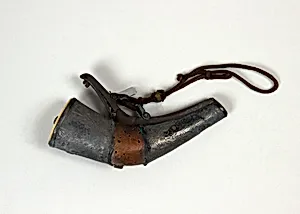
Medium
Wood, horn, silver
Dimensions
L. 6 in. (15.2 cm); D. 1 3/8 in. (3.5 cm); Wt. 4.1 oz. (116.2 g)
Classification
Firearms Accessories-Flasks & Primers
Culture
Turkish
Department
Arms and Armor
Museum
Metropolitan Museum of Art, New York, NY
Credit
Bequest of George C. Stone, 1935
Accession Number
36.25.2349
Rights
Public Domain
Art Historical Context
This exquisite 18th-century Turkish primer, crafted from wood, horn, and, served as a vital accessory for muzzle-loading firearms in the Ottoman. Measuring just 6 inches long and weighing a mere 4.1 ounces, it held the fine priming powder ignited by a spark to set off the main gunpowder charge. Displayed in the Metropolitan Museum of Art's Arms and Armor Department (bequest of George C., 1935), it exemplifies the blend of functionality and finesse in Ottoman military craftsmanship. During the 18th century, the Ottoman Turks were renowned for their innovative firearms, drawing from Persian, European, and Islamic traditions. Primers like this were essential for matchlock and flintlock weapons used by janissaries and cavalry, enabling reliable firing in battle or hunting. The use of horn—a lightweight, waterproof material—for the body, combined with wooden reinforcements and silver accents, highlights practical engineering while allowing for subtle decoration, reflecting the cultural value placed on elegant weaponry. Though unsigned by a known artist, this compact primer reveals the artistry in everyday arms: its precise dimensions ensured portability, while the materials' natural sheen and silver highlights added a touch of luxury. A window into Ottoman ingenuity, it invites us to appreciate how beauty and utility intertwined in 18th-century warfare.