
Hand Cannon
Unknown Artist
19th century
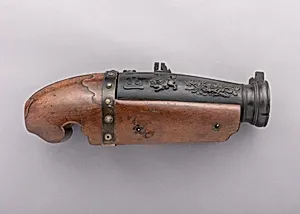
Medium
Bronze, wood
Dimensions
L 18 3/4 in. (47.6 cm);
Classification
Firearms-Hand Cannon
Culture
Japanese
Department
Arms and Armor
Museum
Metropolitan Museum of Art, New York, NY
Credit
The Collection of Giovanni P. Morosini, presented by his daughter Giulia, 1932
Accession Number
32.75.238
Rights
Public Domain
Art Historical Context
This exquisite Japanese hand cannon, dating to the 19th century, exemplifies the fusion of artistry and functionality in Arms and Armor. Crafted bronze and wood, it measures 18 3/4 inches in length, making it a compact yet formidable handheld firearm. The bronze barrel likely provided durability and a resonant finish, while the wooden stock offered ergonomic balance for the user—hallmarks of Japanese metalworking and woodworking traditions refined over centuries. In 19th-century Japan during the late Edo period transitioning to the Meiji Restoration, hand cannons like this represented the evolution of gunpowder weaponry introduced via Portuguese traders in the 1540s. Though samurai favored swords, these firearms gained prominence in warfare and hunting, symbolizing a shift toward modern arms amid isolationist policies. The unknown artisan's skill in forging bronze suggests meticulous casting techniques, blending utilitarian design with subtle aesthetic elegance. Now housed in the Metropolitan Museum of Art's Arms and Armor Department, this piece entered the collection through the generous gift of Giovanni P. Morosini's daughter Giulia in 1932. It invites visitors to ponder Japan's dynamic martial history, where beauty and lethality coexisted.