
Princely Couple
Unknown Artist
1400–1405
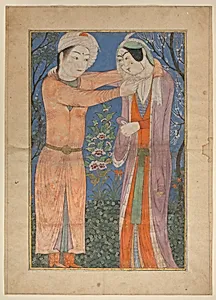
Medium
Opaque watercolor and gold on paper
Dimensions
H. 19 1/4 in. (48.9 cm) W. 12 9/16 in. (31.9 cm)
Classification
Codices
Department
Islamic Art
Museum
Metropolitan Museum of Art, New York, NY
Credit
Cora Timken Burnett Collection of Persian Miniatures and Other Persian Art Objects, Bequest of Cora Timken Burnett, 1956
Accession Number
57.51.20
Rights
Public Domain
Tags
Art Historical Context
Nestled within the rich tradition of Persian miniature painting,Princely Couple* (ca. 1400–1405) is a luminous folio from an illuminated manuscript, or codex, crafted by an unknown artist. This opaque watercolor and gold on paper work, measuring nearly 19 by 13 inches, captures an intimate moment between a noble man and woman—evoking themes of courtly love and companionship. Housed in the Metropolitan Museum Art's Islamic Art Department part of the Cora Tim Burnett Collection, it exemplifies the exquisite artistry of early Timurid Persia. Created during the dawn of the Timurid era, a golden age for Persian painting under the patronage of rulers like Timur, this piece reflects the era's fascination with idealized romance and princely elegance. Miniatures like this adorned luxurious manuscripts of poetry and epics, serving as visual poetry that brought literary tales to life for elite audiences. The use of vibrant opaque watercolors—essentially gouache—layered with shimmering gold created a jewel-like intensity, flattening space in a stylized, otherworldly manner typical of the style. Its cultural significance lies in portraying harmonious unions amid opulent settings, symbolizing virtues like devotion and beauty in Islamic courtly culture. Though the artist remains anonymous, as was common, the work's precision and glow invite visitors to ponder the timeless allure of human connection across centuries.