
ca. 1830
Medium
Woodblock print (surimono); ink and color on paper
Dimensions
7 3/4 x 7 1/8 in. (19.7 x 18.1 cm)
Classification
Prints
Culture & Period
Japan · Edo period (1615–1868)
Department
Asian Art
Museum
Metropolitan Museum of Art, New York, NY
Credit
Rogers Fund, 1921
Accession Number
JP1236
Rights
Public Domain
Tags
Art Historical Context
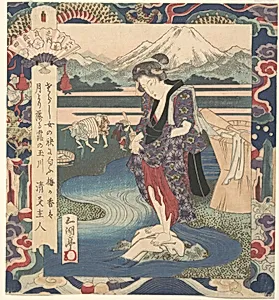
This exquisite woodblock print, titled simply *Print*, is the work of Yashima Gakutei, a master of the ukiyo-e tradition active in Kyoto during Japan's Edo period (1615–1868). around 1830, it exemplifies *surimono*—privately commissioned prints produced for elite patrons, often to celebrate New Year's or poetry gatherings. Unlike mass-produced ukiyo-e, surimono like this one, measuring just 7 3/4 x 7 1/8 inches, were crafted on fine paper with vibrant inks and colors, sometimes enhanced by subtle embossing or mica for a luxurious tactile quality. The composition captures a serene rural scene: women engaged in laundry by a winding river, framed by majestic mountains. Such motifs evoke the harmonious beauty of everyday life in Edo Japan, blending bijin-ga (images of elegant women) with poetic landscapes. Gakutei's precise lines and delicate color gradients highlight his skill in *ukiyo-e* techniques, where woodblocks allowed for intricate multi-color printing from separate blocks. Housed in the Metropolitan Museum of Art's Asian Art Department (Rogers Fund, 1921), this print offers a window into 19th-century Japan's refined aesthetic culture, where art intertwined with literature and seasonal rituals, inviting viewers to appreciate the quiet poetry of nature and human labor.
About the Artist
Yashima Gakutei · 1786–1868
Yashima Gakutei (c. 1786–1868), born in Osaka as the illegitimate son of a Tokugawa shogunate samurai named Hirata, adopted the name from his mother's subsequent marriage into the Yashima clan. Little is documented about his early years beyond these familial ties, but he pursued artistic training under the esteemed ukiyo-e masters Totoya Hokkei and Katsushika Hokusai, absorbing their precision in ...