
1703
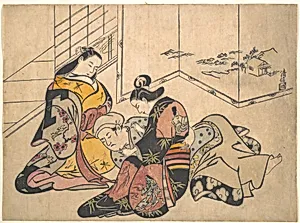
Medium
Woodblock print (hand-colored); ink and color on paper
Dimensions
10 3/4 x 14 1/2 in. (27.3 x 36.8 cm)
Classification
Prints
Culture & Period
Japan · Edo period (1615–1868)
Department
Asian Art
Museum
Metropolitan Museum of Art, New York, NY
Credit
Harris Brisbane Dick Fund and Rogers Fund, 1949
Accession Number
JP3071
Rights
Public Domain
Tags
Art Historical Context
Created in 1703 during Japan’s Edo period, this hand-colored woodblock print by Torii Kiyonobu I exemplifies the early flowering of ukiyo-e, or “pictures of the floating world.” Kiyonobu, of the influential Torii, specialized in depictions of kabuki actors and theatrical scenes. The print’s modest scale and delicate application of ink and color on paper reflect the era’s growing demand for affordable, reproducible images that captured the vibrancy of urban entertainment. Woodblock printing allowed artists to reach a broad audience beyond the elite, transforming fleeting performances into lasting visual souvenirs. Kiyonobu’s bold outlines and expressive poses helped define the Torii style, which became synonymous with actor portraits. The presence of both men and women in the composition hints at the lively social world of the theater district, where gender roles and dramatic narratives intertwined on stage. Today, this work offers a window into early eighteenth-century Japanese popular culture, illustrating how art, commerce, and performance converged to shape public taste during the Edo period.
About the Artist
Torii Kiyonobu I · 1664–1729
Torii Kiyonobu I (1664–1729), born Shōbei in Osaka, was the second son of Torii Kiyomoto, a prominent kabuki actor specializing in onnagata roles and a painter of theater signboards. He studied painting under his father as well as Yoshida Hanbei and Hishikawa Moronobu, the pioneering ukiyo-e master whose figure styles profoundly shaped his early work. In 1687, at age twenty-four, Kiyonobu accompan...