
Classification
Department
Smithsonian Collection
Museum
Smithsonian American Art Museum
Credit
Gift of Eleanor and Sarah Hewitt
Accession Number
1920-36-353
Rights
Public Domain
About this artwork
Research in Progress
Art Historical Context
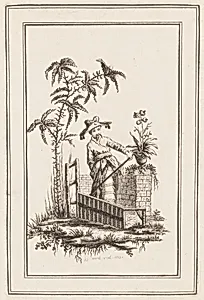
Jean-Baptiste Pillement (1728–1808), a versatile French artist of the Rococo era, was renowned for his delicate landscapes, floral motifs, and chinoiserie designs that blended European elegance with exotic influences. Active across Europe—from Portugal and England to Poland—he created decorative works for tapestries, wallpapers, and porcelain, influencing 18th-century ornamental arts. This print, though its exact date and medium remain under research, exemplifies his mastery of printmaking, a technique he used to disseminate intricate patterns widely among artisans and collectors. Pillement's prints often featured lush, imaginary scenes with swirling foliage, playful figures, and a lightness characteristic of Rococo's playful escape from Baroque grandeur. As affordable reproductions, they played a key role in spreading his style, inspiring textile designers and gardeners alike. Fun fact: His motifs were so popular that they appeared in 19th-century American chintz fabrics, bridging Old World artistry with New World tastes. Generously gifted to the Smithsonian American Art Museum by collectors Eleanor and Sarah Hewitt—pioneers in design preservation—this piece invites ongoing discovery. While details are still emerging, it highlights Pillement's enduring legacy in decorative innovation.