
Classification
Department
Smithsonian Collection
Museum
Smithsonian American Art Museum
Credit
Gift of Eleanor and Sarah Hewitt
Accession Number
1920-36-400
Rights
Public Domain
About this artwork
Research in Progress
Art Historical Context
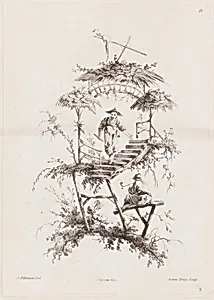
Jean-Baptiste Pillement (1728–1808), a versatile French Rococo artist, was renowned for his delicate landscapes, ornate floral motifs, and chinoiserie-inspired designs. Active across Europe—from Portugal and England to Poland—he bridged painting, etching, and decorative arts, influencing textile and wallpaper patterns that adorned aristocratic interiors. This print, though its exact date and medium remain under research, exemplifies his mastery of printmaking, a technique he used to disseminate intricate compositions with fluid lines and playful asymmetry characteristic of the Rococo era. Pillement's works often captured the elegance of nature with a whimsical touch, blending realism and fantasy to evoke the refined tastes of 18th-century courts. As a print, this piece likely served both artistic and reproductive purposes, allowing broader access to his stylish vignettes amid the Enlightenment's growing print culture. Its presence in the Smithsonian American Art Museum's collection, gifted by collectors Eleanor and Sarah Hewitt, underscores the enduring appeal of European decorative arts in American institutions. While ongoing research promises deeper insights, this artwork invites visitors to appreciate Pillement's role in the opulent visual language of Rococo, a movement celebrating joy and ornament before Neoclassicism's rise.