
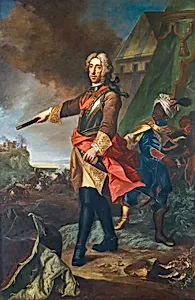
Prinz Eugen von Savoyen als Feldherr
um 1725/1730
Medium
Öl auf Leinwand
Dimensions
272 × 163,5 cm
Classification
Gemälde
Department
Belvedere Collection
Museum
Belvedere
Credit
Belvedere, Vienna
Accession Number
11515
Rights
Public Domain
About this artwork
Leicht erhöht steht Prinz Eugen von Savoyen (1663–1736) mit dem Marschallstab in sicherem Abstand zum Kampfgeschehen im Hintergrund. Das Vorbild für die Haltung des Prinzen lieferte Hyacinthe Rigauds berühmtes Staatsporträt Ludwigs XIV. von Frankreich. Dieser hatte Eugen einst die Aufnahme in sein Heer verweigert. Der klare Verweis auf den Sonnenkönig offenbart, wie sehr es in barocken Porträts um Inszenierung geht, denn die luxuriöse Kleidung samt Prunkharnisch ist kaum für den Einsatz im Feld ...
Art Historical Context
In the grand tradition of Baroque portraiture, Johann Gottfriedbach's *Prinz Eugen von Savoyen Feldherr* (c. 1725–1730) captures the renowned military leader Prince Eugene of Savoy (3–1736) in a commanding pose. Standing slightly elevated with his marshal's baton in hand, Eugene gazes confidently from a safe vantage above a distant battlefield. This massive oil on canvas (272 × .5 cm) from the Belvedere Collection in Vienna exemplifies the era's focus on heroic idealization, glorifying a key Habsburg commander who triumphed against Ottoman forces and French rivals. Auerbach cleverly draws inspiration from Hyacinthe Rigaud's iconic state portrait of Louis XIV—the Sun King who once rejected Eugene's plea to join his army. The borrowed stance underscores Baroque portraiture's theatricality, where opulent clothing and an ornate breastplate prioritize splendor over battlefield practicality. Painted during peacetime, the generic battle scene in the background symbolizes Eugene's enduring legacy rather than a specific victory, transforming history into timeless propaganda. This work invites us to appreciate how 18th-century artists staged power, blending flattery with subtle irony to immortalize Europe's military elite.