
Prisoner jar
Unknown Artist
200–800 CE
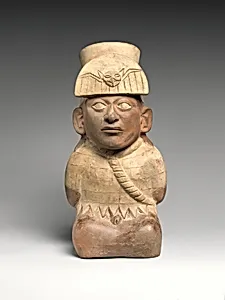
Medium
Ceramic, slip
Dimensions
H. 10 3/4 × W. 5 1/4 × D. 4 1/2 in. (27.3 × 13.3 × 11.4 cm)
Classification
Ceramics-Containers
Culture
Moche
Department
Arts of Africa, Oceania, and the Americas
Museum
Metropolitan Museum of Art, New York, NY
Credit
Gift of Judith Riklis, 1983
Accession Number
1983.546.6
Rights
Public Domain
Tags
Art Historical Context
This striking *Prisoner Jar*, crafted by an unknown Moche artist between200–800 CE, the vivid ceramic artistry of ancient Peru's northern coast. Standing about 10¾ inches tall, the vessel features modeled figures of bound male prisoners, their expressions and postures conveying tension and defeat. Made from ceramic with slip—a liquid clay suspension used for painting fine details—the jar's glossy red and cream tones highlight the sculptural forms, typical of Moche portraiture vessels. The Moche culture, flourishing in the Larco Valley region without written records, relied on such ceramics to document their world. Prisoner motifs, often depicting war captives or ritual victims, reflect the society's martial prowess and sacrificial practices, where elite warriors paraded bound foes before offering them to deities. These jars, sometimes used as funerary urns or ritual containers, offer rare glimpses into Moche power dynamics and cosmology. Housed in the Metropolitan Museum of Art's Arts of Africa, Oceania, and the Americas department (gift of Judith Riklis, 1983), this piece showcases the Moche's technical mastery in stirrup-spout forms and naturalistic modeling, blending utility with profound storytelling for posterity.