
Prisoners on a Projecting Platform, from "Carceri d'invenzione" (Imaginary Prisons)
ca. 1749–50
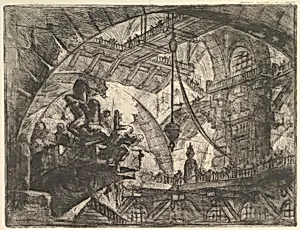
Medium
Etching, engraving, sulphur tint or open bite, burnishing; first state of four (Robison)
Dimensions
Sheet: 19 1/2 x 25 3/16 in. (49.5 x 64 cm) Plate: 16 1/8 x 21 1/4 in. (41 x 54 cm)
Classification
Prints
Department
Drawings and Prints
Museum
Metropolitan Museum of Art, New York, NY
Credit
Harris Brisbane Dick Fund, 1937
Accession Number
37.45.3(33)
Rights
Public Domain
Tags
Art Historical Context
Step into the shadowy depths of Giovanni Battista Pir's *Prisoners on a Projecting*, a captivating etching from his renowned series *Carceri'invenzione* (inary Prisons), created around 1749–50. Piranesi, an Italian architect and visionary artist of the Enlightenment era, crafted these 14 intricate prints (later expanded) to evoke colossal, labyrinthine dungeons that blend architectural grandeur with human despair. This first-state impression, measuring about 16 x 21 inches on the plate, prisoners perched precariously on a projecting platform amid towering vaults and staircases, symbolizing entrapment and the sublime terror of unbounded space. Piranesi's mastery shines in his innovative techniques: etching and engraving combined with sulphur tint or open bite for moody depth, and burnishing for subtle highlights. These methods create dramatic contrasts of light and shadow, immersing viewers in an otherworldly realm that critiques tyranny while celebrating neoclassical architecture. Far from mere fantasy, the *Carceri* influenced Romantic artists and architects, embodying 18th-century fascination with ruins and the irrational. Housed in the Metropolitan Museum of Art's Drawings and Prints department (Harris Brisbane Dick Fund, 1937), this rare first state offers a glimpse into Piranesi's evolving vision—later states grew denser. It's a poignant reminder of how art can conjure psychological prisons, inviting us to ponder freedom amid confinement.
About the Artist
Giovanni Battista Piranesi|Giovanni Bouchard · 1720–1778
Giovanni Battista Piranesi (1720–1778) was an Italian printmaker, architect, and antiquarian whose visionary etchings of Rome and imaginary prisons revolutionized architectural representation and profoundly influenced both Neoclassicism and Romanticism. Piranesi stands as one of the most important printmakers of the eighteenth century, fundamentally shaping European perceptions of ancient Rome an...