
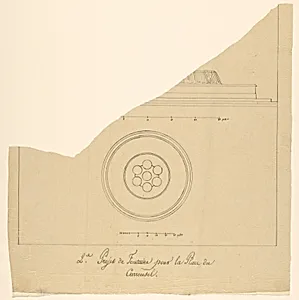
Project for a Fountain for La Place du Carrousel
ca. 1806
Medium
Pen and black ink on tracing paper
Dimensions
Sheet: 13 3/4 x 10 in. (34.9 x 25.4 cm) (maximum)
Classification
Drawings|Ornament & Architecture
Department
Drawings and Prints
Museum
Metropolitan Museum of Art, New York, NY
Credit
Purchase, Brooke Russell Astor Bequest, 2013
Accession Number
2013.532.5
Rights
Public Domain
Tags
Art Historical Context
In the early 19th century, Napoleon Bonaparte reshaped Paris into an imperial capital, architects like Pierre-Françoiséonard Fontaine dreamed big. This delicate drawing, *Project for a Fountain for La Place du Carrousel (ca. 1806), captures one such vision: an ornate fountain destined for the bustling square near the Louvre and Tuileries Palace. Fontaine, a master of Neoclassicism and frequent collaborator with Charles Percier infused his designs with the grandeur of ancient Rome, tailored to Napoleon's Empire style—think bold symmetry, classical motifs, and public splendor. Executed in pen and black ink on tracing paper—a practical medium for overlaying and refining architectural plans—this 13¾ × 10-inch sheet reveals the meticulous preparatory process behind urban monuments. Tracing paper's translucency allowed Fontaine to iterate ideas efficiently, blending ornamentation with functionality for a fountain that would have served as both a hydraulic centerpiece and a symbol of imperial power. Though this exact project for Place du Carrousel wasn't built, it highlights Fontaine's role in Paris's transformation during the Napoleonic era. Today, at The Metropolitan Museum of Art, it invites us to ponder the interplay of ambition, artistry, and city planning that still defines the French capital.
About the Artist
Pierre François Léonard Fontaine · 1762–1853
Pierre François Léonard Fontaine (1762–1853) was a pivotal figure in French neoclassical architecture, renowned for his masterful interiors, urban planning, and decorative designs that defined the Empire style. Born in Pontoise to architect and fountain designer Pierre Fontaine, he assisted his father on hydraulic projects at the Château de L'Isle-Adam in 1778–1779 before moving to Paris in 1779. ...