
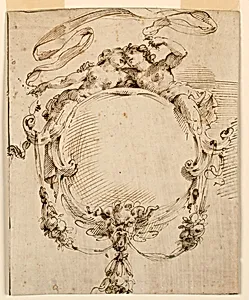
Project for an Escutcheon
Medium
ornament
Classification
ornament
Department
Smithsonian Collection
Museum
Smithsonian American Art Museum
Credit
Museum purchase through gift of various donors and from Eleanor G. Hewitt Fund
Accession Number
1938-88-465
Rights
Public Domain
About this artwork
Research in Progress
Art Historical Context
**Project for an Escut** *Carlo Bianconi (Italian, 1732–1802), ca. 1760* *Ornament, Smithsonian American Art Museum*Step into the elegant world of 18th Italian design with Carlo Bianconi's *Project for an Escutcheon Created around 1760, this ornamental work showcases Bianconi's skill as a designer during a time when Italy's artistic scene blended Rococo flourish with emerging Neoclassical restraint. An "escutcheon" refers to a heraldic shield or decorative emblem, often used in architecture, furniture, or coats of arms to convey status and identity. Bianconi's "project" likely represents a preparatory design, highlighting the meticulous planning behind opulent decorative arts. As an Italian artist active in Bologna and beyond, Bianconi specialized in engravings and ornamental motifs that influenced European interiors and objects. This piece, classified simply as "ornament," exemplifies the era's fascination with intricate patterns—think swirling motifs and balanced symmetry that adorned palaces and public spaces. Acquired through museum purchase with donor support, it reflects the Smithsonian American Art Museum's commitment to global decorative traditions, even as research continues to uncover more about its creation. Though details are still emerging, this escutcheon design invites us to appreciate the artistry of everyday embellishment, bridging heraldry's noble past with 1760s innovation. A delightful glimpse into how Italians crafted beauty into shields of prestige! (198 words)