
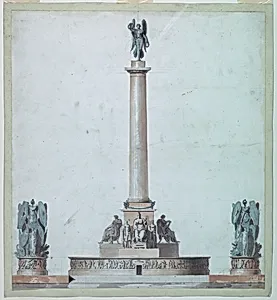
Project: The elevation of a Victory monument
Medium
architecture
Classification
architecture
Department
Smithsonian Collection
Museum
Smithsonian American Art Museum
Credit
Museum purchase through gift of various donors and from Eleanor G. Hewitt Fund
Accession Number
1938-88-7183
Rights
Public Domain
About this artwork
Research in Progress
Art Historical Context
Giuseppe Valadier, a leading Italian neoclassical architect (1762–1839), created *Project: The elevation of Victory monument* around 1820. This architectural drawing showcases Valadier's mastery in designing grand public structures, reflecting the era's emphasis on monumental architecture to commemorate triumphs. As a key figure in Rome's urban renewal during the Napoleonic period and Bourbon restoration, Valadier blended classical Roman motifs with innovative engineering, seen in his restorations of ancient sites like the Ponte Milvio. Victory monuments were emblematic of early 19th-century Europe rising amid post-revolutionary fervor to symbolize national pride and imperial glory. Valadier's elevation—a detailed frontal view—likely illustrates a towering obelisk or column adorned with allegorical figures, evoking antiquity while serving contemporary propaganda. His precise draftsmanship, typical of neoclassical techniques, used measured perspectives and ornate detailing to convey scale and harmony. Housed in the Smithsonian American Art Museum through a museum purchase and donor gifts, this work highlights the transatlantic appreciation for Italian design. Though research continues, it offers visitors a window into how architecture bridged history and heroism, inspiring awe in an age of empire.