
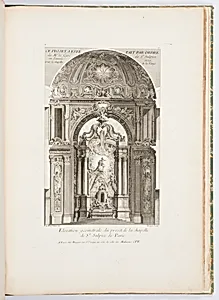
Projet de la chapelle de St. Sulpice de Paris (Design for the St. Sulpice Chapel of Paris), plate 101, in Oeuvres de Juste-Aurèle Meissonnier (Works by Juste-Aurèle Meissonnier)
Medium
architecture
Classification
architecture
Department
Smithsonian Collection
Museum
Smithsonian American Art Museum
Credit
Purchased for the Museum by the Advisory Council
Accession Number
1921-6-212-59
Rights
Public Domain
About this artwork
Research in Progress
Art Historical Context
This architectural design, titled *Projet de la chapelle de St. Sulpice de Paris*, is plate 101 from the collected *Oeuvres* of Juste-Aurèle Meissonnier, dated 1748. Born in Italy in 1695 and active in France until 1750, Meissonnier was a versatile designer whose work encompassed architecture, interiors, and decorative arts. This piece presents his vision for a chapel within Paris’s Church of Saint-Sulpice, capturing the refined elegance of mid-18th-century French taste during the reign of Louis XV. Meissonnier is celebrated as a leading figure of the Rococo movement, known for its fluid curves, asymmetry, and playful ornament drawn from nature. In architectural designs like this one, he translated those qualities into spatial proposals that blended structure with lavish decoration, creating environments of lightness and movement. As an engraving from his published works, the plate allowed his ideas to circulate widely among patrons and fellow artists, amplifying the influence of Rococo beyond built projects. Held in the Smithsonian American Art Museum, this work offers a window into the creative process of one of the era’s most inventive designers. It invites viewers to imagine how such a chapel might have transformed a sacred space with intricate, harmonious details. Though further research continues, the design stands as a testament to Meissonnier’s lasting impact on European architecture and the decorative arts.