
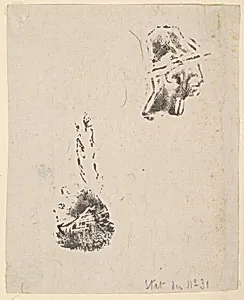
Proof from a block of sketches
1834–75
Medium
Woodcut on china paper, laid down on card; second (final) state; posthumous impression
Dimensions
sheet: 4 15/16 x 4 in. (12.5 x 10.1 cm)
Classification
Prints
Department
Drawings and Prints
Museum
Metropolitan Museum of Art, New York, NY
Credit
Gift of Dr. Van Horne Norrie, 1917
Accession Number
17.34.11
Rights
Public Domain
Tags
Art Historical Context
Jean-François Millet’s “Proof from a block of sketches” offers an glimpse into the working methods of one of the leading figures of the Barbizon School. Active from the 1830s his death in 1875, Millet devoted career to portraying rural life with quiet dignity. This small woodcut, measuring just under five inches square, quick studies of human profiles—simple, expressive lines that reveal his keen observation of ordinary people. Printed on delicate china paper and mounted on card, the work is a posthumous impression of the second and final state. Woodcut, one of the oldest printmaking techniques, allowed Millet to explore bold contours and negative space with economical means. Because the block was printed after the artist’s lifetime, the sheet preserves a record of his spontaneous sketching rather than a finished composition intended for wide distribution. Acquired by the Metropolitan Museum in 1917 as a gift, the print highlights Millet’s enduring influence on later generations interested in the poetry of everyday forms. Its modest scale and focus on profile studies remind viewers how even the smallest graphic experiments can illuminate an artist’s larger vision of humanity.
About the Artist
Jean-François Millet · 1814–1875
Jean-François Millet (1814-1875) was a French painter and one of the founders of the Barbizon school, whose dignified depictions of peasant laborers transformed how art could represent rural life. His monumental images of sowers, gleaners, and field workers elevated common people to subjects previously reserved for mythological or historical figures, making him a pivotal figure in the development ...