
Propylaeum
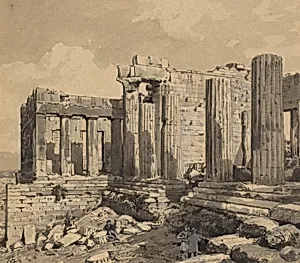
Medium
pen and black ink and watercolor heightened with white over black chalk and touches of graphite
Dimensions
Overall: 14.4 x 15.9 cm (5 11/16 x 6 1/4 in.) support: 48.8 x 33.7 cm (19 3/16 x 13 1/4 in.)
Classification
Drawing
Department
CG-E
Museum
National Gallery of Art, Washington, D.C.
Credit
Gift of Dr. Dieter Erich Meyer
Accession Number
1977.6.2
Rights
Public Domain
Art Historical Context
Visitors to the National Gallery of Art can admire *Propylaeum* (1890), a delicate drawing by German artist Themistocles von Eckenbrecher, gifted by Dr. Dieter Erich Meyer. Von Eckenbrecher, a Realist painter and traveler, captured the majestic Propylaea—the grand gateway to Athens' Acropolis—in this intimate study. Created during the late 19th century, when European artists flocked to Greece amid rising archaeological fervor, the work reflects a Romantic fascination with classical antiquity, blending precise observation with evocative atmosphere. Executed on a modest scale (14.4 x 15.9 cm), the piece employs a sophisticated mixed-media technique: pen and black ink for crisp architectural lines, watercolor washes for subtle tonal depth, heightened with white for luminous highlights, all layered over black chalk and graphite underdrawing. This method, common in 19th-century sketchbooks, allowed artists like von Eckenbrecher—known for his Orientalist and Mediterranean landscapes—to achieve both fidelity to ancient forms and a sense of weathered grandeur on a portable support. Housed in the museum's CG-E department and classified as a drawing, *Propylaeum* offers a window into how 1890s artists reimagined timeless ruins, bridging historical reverence with technical innovation. A gem for lovers of classical architecture and draftsmanship!