
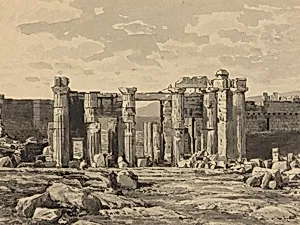
The Propylaeum from the East
Medium
pen and black ink and watercolor over black chalk and touches of graphite
Dimensions
Overall: 11.9 x 16.2 cm (4 11/16 x 6 3/8 in.) support: 48.8 x 33.7 cm (19 3/16 x 13 1/4 in.)
Classification
Drawing
Department
CG-E
Museum
National Gallery of Art, Washington, D.C.
Credit
Gift of Dr. Dieter Erich Meyer
Accession Number
1977.6.14
Rights
Public Domain
Art Historical Context
Step into the ancient grandeur of Athens with *The Propylaeum from the East*, a delicate 1890 drawing by German artist Themistocles von Eckenbrecher (1853–1938). Capturing the iconic gateway to the Acropolis—built in 437 BCE by architect Mnesicles as part of Pericles' monumental rebuilding—this intimate sketch (11.9 x 16.2 cm) offers a Romantic view from the east, evoking the timeless allure of classical ruins amid late 19th-century European fascination with Greece. Von Eckenbrecher, known for his luminous landscapes and Orientalist travels, employed a masterful mixed-media technique: black chalk and graphite for subtle underdrawing, precise pen and black ink lines for architectural detail, and watercolor washes for atmospheric depth on a larger support sheet. This layered approach, typical of academic sketchbooks, allowed for on-site precision during his journeys, blending technical rigor with evocative mood. Housed in the National Gallery of Art as a gift from Dr. Dieter Erich Meyer, this work highlights the era's archaeological revival—think Schliemann's Troy excavations—and von Eckenbrecher's role in preserving antiquity's splendor for modern eyes. A gem for lovers of history and draftsmanship, it invites you to trace the Propylaeum's weathered columns, bridging 2,500 years in a single glance.