
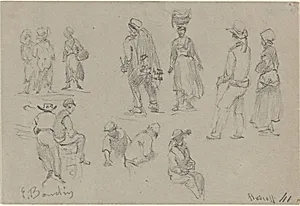
Provincial Figures
1801 to 1825
Medium
graphite on gray wove paper
Dimensions
overall: 9.4 x 13.8 cm (3 11/16 x 5 7/16 in.)
Classification
Drawing
Department
CG-E
Museum
National Gallery of Art, Washington, D.C.
Credit
Gift of the Christian Humann Foundation
Accession Number
1996.128.5
Rights
Public Domain
Art Historical Context
Eugène Boudin’s “Provincial Figures” is a modest yet evocative graphite drawing on gray wove paper, created between 1801 and 1825. At just 9.4 by 13.8 centimeters, the small scale invites close looking, revealing Boudin’s sensitive handling of line to suggest everyday people in a rural or small-town setting. The cool gray paper serves as a mid-tone, allowing the artist to build form through delicate shading and subtle highlights. Though best known for his luminous beach scenes that helped shape Impressionism, Boudin often turned to quick sketches like this one to record fleeting gestures and costumes. Graphite’s immediacy made it ideal for capturing such moments on the spot, preserving the quiet rhythm of provincial life. Now in the collection of the National Gallery of Art thanks to the Christian Humann Foundation, the drawing offers visitors an intimate window into Boudin’s early practice and his lifelong interest in ordinary figures.
About the Artist
Eugène Boudin · 1824–1898
Eugène Louis Boudin was born on July 12, 1824, in Honfleur, Normandy, the son of a harbor pilot. When his family relocated to Le Havre, his father opened a stationery and picture-framing shop, and it was there that the young Boudin first encountered working artists. Artists such as Constant Troyon and Jean-François Millet recognized his talent and urged him toward a career in art. In 1850, a munic...