
Pryor Smallwood
ca. 1798
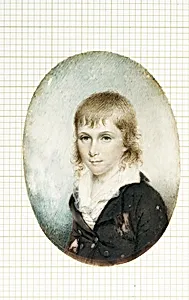
Medium
Watercolor on ivory
Dimensions
2 5/8 x 2 1/4 in. (7.1 x 5.2 cm)
Classification
Painting, miniature
Culture
American
Department
The American Wing
Museum
Metropolitan Museum of Art, New York, NY
Credit
Gift of Gloria Manney, 2006
Accession Number
2006.235.134
Rights
Public Domain
Tags
Art Historical Context
James Peale’s miniature portrait *Pryor Smallwood* captures the likeness of a young boy in delicate watercolor on ivory, a medium prized in late-eighteenth-century America for its luminous quality and intimate scale. Painted around 1798, the work measures just over two-and-a-half inches high, suggesting it was intended to be worn or carried as a personal keepsake. Peale, a member of Philadelphia’s celebrated artistic family, specialized in such portraits, bringing a refined sensitivity to the features and expression of his sitters. In the years following the American Revolution, miniature portraits became symbols of familial affection and social standing. This example reflects the era’s taste for restrained elegance and the growing demand among middle- and upper-class families for affordable yet refined likenesses. The ivory support allowed Peale to achieve subtle gradations of tone and a soft, almost ethereal finish that enhances the boy’s youthful presence. Today housed in the Metropolitan Museum’s American Wing, the portrait offers visitors a glimpse into the private lives of early national citizens and the technical virtuosity of one of the period’s leading miniaturists.
About the Artist
James Peale · 1749–1831
James Peale was an American painter born in 1749, the younger brother of the more famous Charles Willson Peale, and a member of one of the most remarkable artistic families in the history of American art. Trained largely by his brother, James worked for many years in Charles Willson's shadow, assisting with portraits and miniatures in the Philadelphia studio before developing his own independent p...