
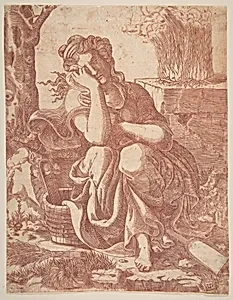
Psyche
ca. 1542
Medium
Engraving
Dimensions
Sheet (trimmed): 9 15/16 × 7 11/16 in. (25.3 × 19.5 cm)
Classification
Prints
Department
Drawings and Prints
Museum
Metropolitan Museum of Art, New York, NY
Credit
The Elisha Whittelsey Collection, The Elisha Whittelsey Fund, 1959
Accession Number
59.596.31
Rights
Public Domain
Tags
Art Historical Context
Behold *Psyche*, a poignant engraving from around 1542, designed by the illustrious Mannerist master Giulio Romano and masterfully executed by engraver Léon Davent. intimate print, measuring about 10 by 7.5 inches on trimmed sheet, captures the mythological figure Psyche in a moment of sadness—evoking the emotional depths of her trials in the ancient tale of Cupid and Psyche, as recounted by Apuleius. Housed in the Metropolitan Museum of Art's Drawings and Prints department, it entered the collection via The Elisha Whittelsey Fund in 1959. Giulio Romano, a star pupil of Raphael who later dazzled at the Gonzaga court in Mantua, was renowned for his dramatic, elegant Mannerist style—marked by elongated forms, dynamic compositions, and emotional intensity. Davent, a skilled French reproductive engraver, translated Romano's designs into precise lines, making high-art imagery accessible through the burgeoning print medium. Engravings like this were revolutionary in the 16th century, democratizing Renaissance and Mannerist aesthetics for collectors across Europe. This work exemplifies how prints bridged elite patronage and wider audiences, preserving Romano's inventive vision long after his designs. Gaze upon Psyche's sorrowful expression, and you'll sense the timeless pull of myth rendered in ink—a testament to art's power to stir the soul.
About the Artist
Giulio Romano|Léon Davent · 1499–1546
Giulio Romano (c. 1499–1546) was the most gifted pupil of Raphael and one of the founding figures of Mannerism, the style that succeeded the High Renaissance in Italy. Born Giulio Pippi in Rome, he entered Raphael's workshop as a boy and proved so talented that by the time of Raphael's death in 1520 he was effectively running the studio and overseeing the completion of major unfinished commissions...