
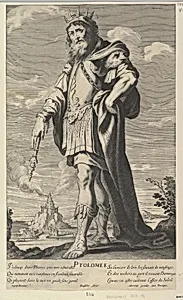
Ptolémée
Medium
Engraving (figure by Rousselet) and etching (background by Bosse)
Dimensions
sheet: 14 x 8 3/8 in. (35.5 x 21.3 cm)
Classification
Prints
Department
Drawings and Prints
Museum
Metropolitan Museum of Art, New York, NY
Credit
Harris Brisbane Dick Fund, 1953
Accession Number
53.601.116
Rights
Public Domain
Tags
Art Historical Context
Created around 1639–40, *Ptolémée* is a striking example of collaborative printmaking in seventeenth-century France. The work combines the talents of several artists: Gilles Rousselet engraved the central figure with precise, linear detail, while Abraham Bosse contributed the etched background. Pierre Mariette and Claude Vignon are also credited, reflecting the common practice of specialists working together to produce refined prints for collectors and scholars. This engraving and etching technique allowed for both sharp definition in the portrait and atmospheric depth in the surrounding space. Such hybrid methods were valued during the period for their ability to convey texture and light effectively on paper. Measuring roughly 14 by 8 inches, the sheet exemplifies the high-quality reproductive prints that circulated images of notable historical and intellectual figures across Europe. Housed in the Metropolitan Museum of Art’s Department of Drawings and Prints, *Ptolémée* entered the collection through the Harris Brisbane Dick Fund in 1953. It offers visitors a window into the technical sophistication and artistic networks that shaped French print culture in the Baroque era.
About the Artist
Abraham Bosse|Pierre Mariette|Gilles Rousselet|Claude Vignon · 1602–1676
Abraham Bosse (1604–1676) was a French printmaker and theorist whose approximately 1,600 etchings provide an unparalleled visual record of 17th-century French life. Born to Huguenot parents in Tours, he trained in Paris under Melchior Tavernier and became a devoted follower of Jacques Callot's technical innovations. Bosse's meticulous etchings depicted subjects ranging from daily life and fashion ...