
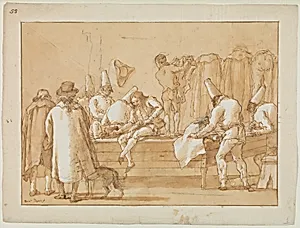
Punchinello as Tailor's Assistant
late 18th–early 19th century
Medium
Pen and brown ink, light brown wash, over black chalk
Dimensions
13 7/8 x 18 1/2 in. (35.3 x 47.0 cm)
Classification
Drawings
Department
Robert Lehman Collection
Museum
Metropolitan Museum of Art, New York, NY
Credit
Robert Lehman Collection, 1975
Accession Number
1975.1.472
Rights
Public Domain
Tags
Art Historical Context
Giovanni Domenico Tiepolo’s *Punchinello as Tailor’s Assistant* captures a lively moment from the artist’s celebrated series of drawings chronicling the adventures of Punchinello, the mischievous hunchbacked clown of the Italian commedia dell’arte. Created in the late eighteenth to early nineteenth century, the scene shows the masked figure engaged in the ordinary task of sewing, blending everyday activity with theatrical fantasy. Tiepolo, son of the renowned Venetian painter Giovanni Battista Tiepolo, carried forward the family’s lighthearted Rococo spirit even as artistic tastes shifted toward neoclassicism. Executed in pen and brown ink with delicate washes over black chalk, the drawing highlights Tiepolo’s fluid draftsmanship and gift for expressive line. The medium allows for both precise detail in the folds of fabric and a soft, atmospheric quality that animates the figures. Measuring roughly 14 by 18½ inches, the sheet feels intimate yet lively, inviting viewers to linger over the playful interaction between Punchinello and his companions. Part of the Robert Lehman Collection at The Metropolitan Museum of Art, this work reflects Tiepolo’s enduring fascination with Punchinello as a vehicle for gentle social satire and storytelling. Through humor and graceful technique, the drawing transforms a simple tailoring scene into a charming window onto Venetian imagination at the close of the eighteenth century.
About the Artist
Giovanni Domenico Tiepolo · 1727–1804
Giovanni Domenico Tiepolo (1727-1804) was a Venetian painter, printmaker, and draftsman whose career spanned the twilight of the Rococo era. Born on August 30, 1727, in Venice as the eldest son of the celebrated Giovanni Battista Tiepolo, he worked both in his father's shadow and as a significant independent artist who developed a distinctly earthbound and humanistic vision. Domenico's importance...