
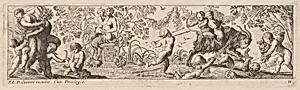
Putti and Satyrs Shooting Arrows
1626
Medium
etching on laid paper
Dimensions
plate: 7.7 × 25.4 cm (3 1/16 × 10 in.) sheet: 8.3 × 26.8 cm (3 1/4 × 10 9/16 in.)
Classification
Department
CG-E
Museum
National Gallery of Art, Washington, D.C.
Credit
Ailsa Mellon Bruce Fund
Accession Number
2015.44.27
Rights
Public Domain
Art Historical Context
**Putti and Satyrs Shooting** *Pierre Brebiette, 1626* Etching on laid paper Step into the playful world of 17th-century French printmaking with Pierre Brebiette's *Putti and Satyrs Shooting Arrows* (1626), a charming etching now in the National Gallery of Art print collection, thanks to the Ailsa Mellon Bruce Fund. This intimate work, with its plate measuring just 7.7 × 25.4 cm (3 1/16 × 10 in.), depicts cherubic putti—those joyful childlike figures from classical mythology—frolicking alongside mischievous satyrs, half-human, half-goat revelers, as they take aim with bows and arrows. The horizontal composition evokes a lively scene of whimsy and mythological mischief, blending innocence with earthy exuberance. Created through etching, a technique where acid etches fine lines into a metal plate for precise, expressive detail, Brebiette showcases the medium's versatility on laid paper, which bears the subtle texture of its handmade fibers. Popular in early 17th-century Europe, such prints allowed artists to disseminate intricate designs affordably, bridging painting and popular culture. This piece from the CG-E department highlights Brebiette's skill in capturing dynamic movement within a compact format, inviting viewers to ponder the timeless allure of myth in art. A delightful gem for print enthusiasts!
About the Artist
Pierre Brebiette · 1598–1642
Pierre Brébiette (c. 1598–c. 1642) was a French painter and etcher whose elegant, sensuous treatment of classical mythology and allegory earned him a significant reputation in early seventeenth-century Paris. Born in Mantes-sur-Seine, Brébiette traveled to Italy as a young man and lived and worked in Rome from around 1617 to approximately 1625, absorbing the influences of ancient sculpture, Renais...