
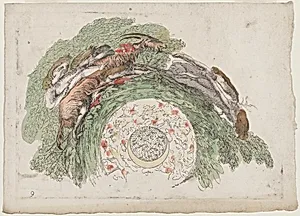
Putti Leading a Goat
c. 1747
Medium
etching, hand-colored with watercolor, on laid paper
Dimensions
plate: 20.4 × 29.2 cm (8 1/16 × 11 1/2 in.) sheet: 23 × 39.5 cm (9 1/16 × 15 9/16 in.)
Classification
Department
CG-E
Museum
National Gallery of Art, Washington, D.C.
Credit
New Century Fund
Accession Number
2014.176.5
Rights
Public Domain
Art Historical Context
In the whimsical etching *Putti Leading a Goat created around 1747 by Italian artist Giovanni Francesco Costa, playful cherubic figures—known as putti—merrily guide a goat through a pastoral scene. These joyful motifs, evoking the lighthearted spirit of 18th-century Rococo, capture a sense of innocence and frolic, common in Roman printmaking circles where Costa worked. The composition, with its plate size of 20.4 × 29.2 cm, invites viewers into a fantastical world blending human whimsy with nature. Costa's mastery shines in the etching technique, where acid bites into a metal plate to create delicate, expressive lines, then enhanced by hand-coloring with watercolor on laid paper. This labor-intensive process transformed affordable prints into vibrant, painterly gems, popular among collectors for their jewel-like tones and accessibility. Hand-coloring added a bespoke charm, bridging the gap between print reproduction and original artwork. Housed in the National Gallery of Art's print collection (thanks to the New Century Fund), this piece exemplifies the era's delight in ornate fantasy, reflecting Italy's enduring Baroque legacy evolving into Rococo elegance. Visitors will appreciate its charm as a window into 18th-century leisure and artistry.
About the Artist
Giovanni Francesco Costa · 1711–1773
Italian, Venice, 1711–1772/73