
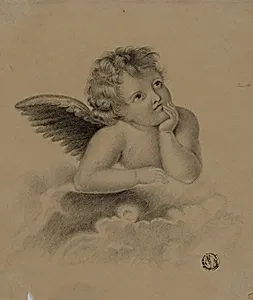
Putto
n.d.
Medium
Black crayon, heightened with traces of white chalk, on tan wove paper
Dimensions
16.4 × 14.2 cm (6 1/2 × 5 5/8 in.)
Classification
crayon
Department
Prints and Drawings
Museum
Art Institute of Chicago
Accession Number
109637
Rights
Public Domain
Art Historical Context
This delicate drawing, *Putto*, by the High Renaissance master Raphael (1483–1520), captures the playful essence a cherubic child figure, known as a *putto*—a motif symbolizing innocence and divine joy that adorned many Renaissance compositions. Housed in the Art Institute of Chicago's Prints and Drawings, this small-scale study (16.4 × 14.2 cm) exemplifies Raphael's preparatory sketches, which were essential for planning grand frescoes and altarpieces like those in the Vatican Stanze. Executed in black crayon heightened with subtle traces of white chalk on tan wove paper, the work showcases Raphael's virtuoso command of line and tonal modeling. The crayon medium allowed for fluid, expressive strokes, while the white highlights add luminous volume to the figure's rounded forms, demonstrating his anatomical precision and graceful idealism. Such drawings were prized by collectors even in Raphael's time, influencing later artists and underscoring the Renaissance elevation of drawing as a foundational art. A testament to Raphael's enduring legacy, this *putto* invites visitors to appreciate the intimate genius behind his monumental paintings, revealing how Renaissance masters like him bridged study and masterpiece with effortless elegance.
About the Artist
Raphael · 1483–1520
Raffaello Sanzio da Urbino, known simply as Raphael, was born on March 28 or April 6, 1483, in the cultured Duchy of Urbino to the court painter and poet Giovanni Santi and his wife Màgia Ciarla. Orphaned young—his mother died when he was eight and his father when he was eleven—Raphael was raised in Urbino's refined court under the guardianship of his paternal uncle Bartolomeo. He received his ear...