Ctrl K
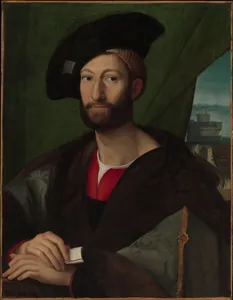
1483–1520
Raffaello Sanzio da Urbino, known simply as Raphael, was born on March 28 or April 6, 1483, in the cultured Duchy of Urbino to the court painter and poet Giovanni Santi and his wife Màgia Ciarla. Orphaned young—his mother died when he was eight and his father when he was eleven—Raphael was raised in Urbino's refined court under the guardianship of his paternal uncle Bartolomeo. He received his earliest training in his father's workshop, where he quickly took on responsibilities managing the studio. By around 1500, he apprenticed under the prominent Umbrian master Pietro Perugino in Perugia, absorbing techniques of balanced composition, lyrical sweetness, and precise perspective that marked his early style.
In his Perugian phase, Raphael produced works like the *Marriage of the Virgin* (1504, Pinacoteca di Brera) and the *Mond Crucifixion* (c. 1503, National Gallery, London), blending Perugino's grace with emerging independence. Moving to Florence around 1504–1508, he encountered the revolutionary influences of Leonardo da Vinci's sfumato and pyramidal groupings, as seen in the *Madonna of the Meadow* (c. 1506) and *Madonna of the Pinks* (c. 1506–1507), and Michelangelo's dynamic anatomy. Summoned to Rome in 1508 by Pope Julius II, Raphael entered his High Renaissance maturity, frescoing the Vatican's Stanza della Segnatura with masterpieces like *The School of Athens* (1509–1511), depicting philosophers in harmonious architectural space, and *The Disputation of the Holy Sacrament* (1510). Under Popes Julius II and Leo X, he led a vast workshop of over fifty assistants, including Giulio Romano, producing papal commissions such as the *Sistine Madonna* (1512) and tapestry cartoons (1515).
Raphael worked in the High Renaissance tradition, achieving clarity of form, effortless composition, and the Neoplatonic ideal of serene human grandeur, synthesizing Umbrian lyricism, Florentine innovation, and Roman monumentality. He also succeeded Donato Bramante as chief architect of St. Peter's Basilica. Engaged to Maria Bibbiena but devoted to his mistress Margherita Luti (immortalized as *La Fornarina*, 1520), Raphael died suddenly on April 6, 1520, at age 37, leaving the *Transfiguration* (1516–1520) unfinished. Forming the great trinity with Leonardo and Michelangelo, his legacy endures in the workshop model he pioneered, influencing Titian, Rubens, Ingres, and beyond, as the "prince of painters" whose balanced beauty defined Renaissance perfection.
![A Marble Horse on the Quirinal Hill [recto]](https://images.artheonmuseum.org/nga/thumb/a-marble-horse-on-the-quirinal-hill-recto-nga-75780.webp)