
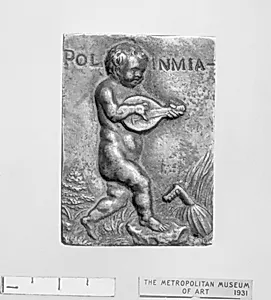
Putto with attributes of the Muse Polymnia
16th century
Medium
Silver gilt
Dimensions
1 7/8 × 1 3/8 in. (4.8 × 3.5 cm)
Classification
Medals and Plaquettes
Culture
German, Nuremberg
Department
European Sculpture and Decorative Arts
Museum
Metropolitan Museum of Art, New York, NY
Credit
Theodore M. Davis Collection, Bequest of Theodore M. Davis, 1915
Accession Number
30.95.131
Rights
Public Domain
Tags
Art Historical Context
In the heart of Renaissance Nuremberg, goldsmith and designer Peter Flötner crafted this exquisite *Putto with Attributes of the Muse Polymnia in the 16th century. Measuring just 1 7/8 × 1 3/8 inches, this silver gilt plaquette depicts a playful cherubic putto—those beloved Renaissance winged infants—holding symbols of Polymnia, the Muse of poetry and song, such as a lyre or musical instruments. The gleaming gilded surface catches the light, emphasizing the fine relief carving that brings the figure to life with delicate curls, flowing drapery, and expressive features. Flötner, a key figure in the Nuremberg school alongside artists like Albrecht Dürer, blended Northern Renaissance precision with classical antiquity's revival. Plaquette like this were prized collectibles for scholars and patrons, functioning as miniature sculptures, devotional tokens, or even cabinet decorations. Silver gilding, a luxurious technique involving mercury gilding over silver, underscored their status as affordable yet opulent art objects amid the era's humanist fervor. Today, housed in The Metropolitan Museum of Art's European Sculpture and Decorative Arts department from the Theodore M. Davis Collection, this piece invites us to ponder the Renaissance joy in mythology—where a tiny putto embodies poetry's divine inspiration, bridging ancient muses with German craftsmanship.
About the Artist
Peter Flötner · 1485–1546
Peter Flötner (c. 1485–1546) was a German sculptor, ornament designer, and medalist whose work played a central role in the transmission of Italian Renaissance decorative vocabulary into the German-speaking lands. Though his exact origins remain uncertain — he may have trained in Augsburg before settling permanently in Nuremberg around 1522 — his formation evidently included exposure to Italian Re...