
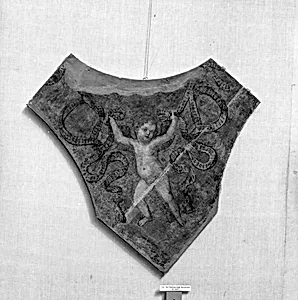
Putto with garlands
ca. 1509
Medium
Fresco, transferred to canvas and attached to wood panels
Dimensions
Overall: 35 7/16 × 42 3/8 in. (90 × 107.6 cm)
Classification
Paintings-Decorative
Culture
Italian, Umbria
Department
European Sculpture and Decorative Arts
Museum
Metropolitan Museum of Art, New York, NY
Credit
Rogers Fund, 1914
Accession Number
14.114.4
Rights
Public Domain
Tags
Art Historical Context
Pinturicchio (Bernardino di Betto), a leading Umbrian painter of the Italian Renaissance, created this charming fresco fragment around 1509. Known for his luminous colors and graceful figures, he often worked on large decorative cycles in Roman palaces and the Siena Cathedral. The putto—a winged cherub frequently linked to Cupid—embodies the era’s revival of classical motifs, blending playful innocence with symbols of love and abundance. Originally painted directly onto wet plaster as part of an architectural frieze, the work showcases the fresco technique’s vibrant, lasting finish. Later transferred to canvas and mounted on wood panels, it survives as a rare decorative piece from Umbria, highlighting how Renaissance interiors celebrated harmony between human and natural forms through garlands and mythological figures. Acquired by the Metropolitan Museum in 1914, this intimate scene invites viewers to appreciate the joyful, ornamental spirit of early sixteenth-century Italian art.