
Textile Fragment
Unknown Artist
4th century
Medium
Wool, linen; plain weave, tapestry weave
Dimensions
Max. H. 11 9/16 in. (29.3 cm) Max. W. 10 13/16 in. (27.5 cm)
Classification
Textiles
Department
Islamic Art
Museum
Metropolitan Museum of Art, New York, NY
Credit
Purchase by subscription, 1889
Accession Number
89.18.195
Rights
Public Domain
Tags
Art Historical Context
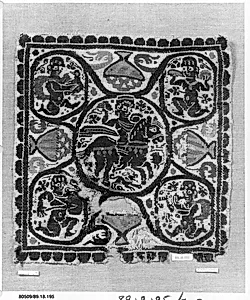
This exquisite textile fragment, dating to the 4 century, hails from the early centuries of Late Antiquity and offers a rare window into the daily life and artistry of its time. Woven in wool and linen, it measures about 11½ by 10⅞ inches and depicts lively scenes of human figures alongside horses—likely evoking hunting, travel, or ceremonial motifs common in ancient Near Eastern or Egyptian textiles. Housed in the Metropolitan Museum of Art's Art department, it reflects the cultural crossroads where pre-Islamic traditions influenced later Islamic textile arts. The fragment's dual techniques—plain weave for a sturdy ground cloth and tapestry weave for vibrant, pictorial inserts—demonstrate sophisticated craftsmanship. Tapestry weaving allowed artisans to create detailed, colorful designs by interweaving dyed yarns, a method prized for its durability and pictorial storytelling. These fragments often survived as remnants from garments, furnishings, or mummy wrappings, preserving vivid narratives that might otherwise be lost. As part of a 1889 purchase, this piece underscores the enduring allure of ancient textiles in museum collections. For visitors, it invites imagination: who rode these horses, and what stories did they carry across deserts and trade routes? A testament to anonymous makers' skill, it bridges antiquity and our modern gaze.