
Pyramus and Thisbe
1514
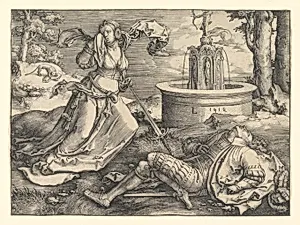
Medium
Engraving
Dimensions
sheet: 4 11/16 x 6 5/16 in. (11.9 x 16 cm)
Classification
Prints
Department
Drawings and Prints
Museum
Metropolitan Museum of Art, New York, NY
Credit
Harris Brisbane Dick Fund, 1934
Accession Number
34.83
Rights
Public Domain
Tags
Art Historical Context
Lucas van Leyden’s 1514 engraving *Pyramus and Thisbe* captures a poignant moment from the ancient Roman tale in Ovid’s *Metamorphoses*. The young lovers, forbidden to marry, arrange a secret meeting but tragically misinterpret events, to their deaths by sword Van Leyden depicts the couple in a wooded landscape, emphasizing their sorrowful expressions and the fatal weapons that underscore themes of love, misunderstanding, and loss. As a leading Northern Renaissance printmaker, Lucas van Leyden was renowned for his intricate engraving technique, which allowed fine lines and rich tonal contrasts on a modest sheet measuring just under 12 by 16 centimeters. Created during the early sixteenth century, when prints were becoming an important means of sharing stories and ideas across Europe, this work demonstrates his skill at condensing dramatic narrative into a small format accessible to a wide audience. Housed in the Metropolitan Museum of Art’s collection of drawings and prints, the engraving reflects the period’s growing interest in classical literature while showcasing the emotional depth achievable through the medium. Its delicate yet powerful rendering invites viewers to reflect on the timeless human experiences of passion and grief.
About the Artist
Lucas van Leyden · 1484–1533
Lucas van Leyden (1494–1533) was a Dutch painter and printmaker who stands among the greatest engravers of the Northern Renaissance. Born in Leiden as either Lucas Hugensz or Lucas Jacobsz, he lived and worked primarily in his native city, achieving international renown that rivaled the German master Albrecht Dürer. Lucas van Leyden revolutionized Netherlandish printmaking and was among the first...