
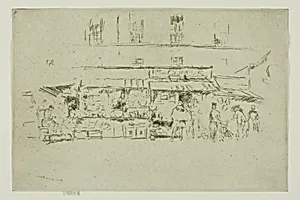
Quai de Montebello
Medium
Etching with foul biting in black ink on buff laid paper
Dimensions
Image, trimmed within platemark: 15 × 22.8 cm (5 15/16 × 9 in.); Sheet: 15.3 × 22.8 cm (6 1/16 × 9 in.)
Classification
etching
Department
Prints and Drawings
Museum
Art Institute of Chicago
Accession Number
73623
Rights
Public Domain
Art Historical Context
James McNeill Whistler’s *Quai de Monteb* (1888) captures a moody glimpse of Paris along the Seine River, at the Quai de Monteello near Notre-Dame. Created during Whistler’s later years, when he frequently visited France, this etching reflects his fascination with urban landscapes and atmospheric effects. As a leading figure in the Aesthetic movement, Whistler prioritized "art for art’s sake," emphasizing harmony of tone and subtle suggestion over literal detail—a philosophy evident in his masterful printmaking. The work is an etching with foul biting in black ink on buff laid paper, a technique where unintended acid corrosion on the plate creates textured, granular effects that enhance depth and mistiness. Measuring just 15 × 22.8 cm, its intimate scale invites close viewing, showcasing Whistler’s precision as one of the 19th century’s greatest etchers. Foul biting, often serendipitous, adds a painterly quality, aligning with his innovative approach during the Etching Revival. Housed in the Art Institute of Chicago’s Prints and Drawings department, this piece exemplifies Whistler’s influence on modern printmaking, blending technical virtuosity with evocative mood. Visitors will appreciate how it evokes the hazy romance of fin-de-siècle Paris, a timeless window into the artist’s subtle genius.
About the Artist
James McNeill Whistler · 1834–1903
James Abbott McNeill Whistler (1834-1903) was an American-born painter and printmaker who became a leading figure in the Aesthetic Movement and pioneer of Tonalism and Japonisme. He revolutionized art by championing "art for art's sake" and treating paintings as visual equivalents of musical compositions, titling works as "arrangements," "harmonies," and "nocturnes" to emphasize formal qualities o...